As in the Game of Life activity, it can cut down on lots of direction and instructional time to use familiar games to support class concepts. This way, many if not all of the students will already know the rules of the game and can simply apply it to the new context without long explanations of procedures that can be difficult for non-auditory learners and those with attention problems.
In order to support our study of the French and Indian War, we played our own iteration of the classic game Battleship. We substituted a land dispute for naval battle and placed forts and settlements in place of submarines and bombers.
The students designed their own boards based on the disputed territory of the French and Indian War and this was really intended to be the key "takeaway" of the game. I wanted the students to remember that these land claims in the Ohio River valley and Appalachian region were at the root of the conflict. Students also had to play the role of either Britain or France and place their forts and settlements according to the territories.
In order to play the game, each student received a grid with three cut-out forts and two settlements. Students should start in the top left corner and color in 25 blue squares to represent French territory. They can choose any 25 square, but they must all be contiguous. The same should be repeated with red squares starting the bottom right corner for British territory. Finally, disputed territory, or the 14 leftover squares in the middle area somewhere, will be colored in purple.
When students' boards are completely colored in, they may cut out the forts and settlements, then place them anywhere in their own country's territory or in the disputed territory. They cannot place forts or settlements in the other country's territory. Now they are ready to play.
Beforehand, I had prepared the game boards using some manila file folders, transparency film, and a stapler. For each student or board, print two copies of the labeled grid, shown below, on transparency film. Staple one copy to each side on the inside of the folder on the left and right edges only. This way, students can slide their boards in and out of the pocket. This is an inexpensive and easy way to to simulate a Battleship board.
When students are ready to play, their prepared grids should slide under the transparency. They can use dry erase markers to mark hits and misses with Xs and Os. I find that it takes students about 15-20 minutes to play one round and during one class period, we have time to switch players and play a second round.
Thursday, May 21, 2015
Tuesday, March 10, 2015
Complexity of Character: Teaching de las Casas to Middle Schoolers
One of the more difficult transitions of teaching history to middle schoolers is to leave behind the relatively simplistic, binary understanding of 'heroes.' In their elementary years, students tended to learn about historical actors as one-dimensional figures in a dichotomy of good and bad. One of the difficulties of doing 'real history' is to recognize that these historical actors are often products of their time and are never wholly good or bad.
I have found that one of the best ways to teach this complexity is with the figure of Bartolome de las Casas. The Spanish missionary came to the Americas in order to convert American Indians into Christians and save their souls. After arriving, however, and witnessing how they dying in droves from overwork, disease, and mistreatment, he wrote the Brief Account of the Destruction of the Indies and advocated to the Spanish government to reform these practices.
As a result, many lessons and textbooks would like to place him firmly in the 'hero' category for being ahead of his time and advocating for the end of slavery. His place in history, however, is a bit more complex. In part, his advocacy for the Native American people was largely based in his perception of them as "lambs" and "innocents," a degrading if sympathetic image. He also is widely known to have encouraged the importation of African slaves from Seville to relieve the Amerindians of their labor, though it is likely he had a very different notion of slavery from what it would become in the Americas.*
So how do we explore this complexity of character with middle schoolers?
The Brief Account of the Destruction of the Indies is a dense read and is written in language that can be cumbersome for many readers. With this in mind, I carefully selected a few excerpts from the text and put them into a worksheet with a right-hand column for glossing notes. In order to think critically about the primary source and reflect on de las Casas himself, I had the students complete a graphic organizer with a partner featuring some critical thinking questions to guide them.
The culminating assignment was a poster featuring the scales of justice and a two-column graphic organizer. Students reflected on the positive aspects of las Casas' legacy, as well as the negative legacy. The also leads students to begin considering what it means for a historical figure to be "of his or her time" and how historiography changes from one generation to the next.
*For further reading on Bartolome de las Casas, his shifting advocacy, and his perceptions of slavery, check out:
Clayton, Lawrence A. (2011). Bartolome de las Casas and the Conquest of the Americas. West Sussex, UK: Wiley-Blackwell.
Zinn, H. (2003). A People's History of the United States: 1492 to Present. New York, NY: HarperCollins.
I have found that one of the best ways to teach this complexity is with the figure of Bartolome de las Casas. The Spanish missionary came to the Americas in order to convert American Indians into Christians and save their souls. After arriving, however, and witnessing how they dying in droves from overwork, disease, and mistreatment, he wrote the Brief Account of the Destruction of the Indies and advocated to the Spanish government to reform these practices.
As a result, many lessons and textbooks would like to place him firmly in the 'hero' category for being ahead of his time and advocating for the end of slavery. His place in history, however, is a bit more complex. In part, his advocacy for the Native American people was largely based in his perception of them as "lambs" and "innocents," a degrading if sympathetic image. He also is widely known to have encouraged the importation of African slaves from Seville to relieve the Amerindians of their labor, though it is likely he had a very different notion of slavery from what it would become in the Americas.*
So how do we explore this complexity of character with middle schoolers?
The Brief Account of the Destruction of the Indies is a dense read and is written in language that can be cumbersome for many readers. With this in mind, I carefully selected a few excerpts from the text and put them into a worksheet with a right-hand column for glossing notes. In order to think critically about the primary source and reflect on de las Casas himself, I had the students complete a graphic organizer with a partner featuring some critical thinking questions to guide them.
The culminating assignment was a poster featuring the scales of justice and a two-column graphic organizer. Students reflected on the positive aspects of las Casas' legacy, as well as the negative legacy. The also leads students to begin considering what it means for a historical figure to be "of his or her time" and how historiography changes from one generation to the next.
*For further reading on Bartolome de las Casas, his shifting advocacy, and his perceptions of slavery, check out:
Clayton, Lawrence A. (2011). Bartolome de las Casas and the Conquest of the Americas. West Sussex, UK: Wiley-Blackwell.
Zinn, H. (2003). A People's History of the United States: 1492 to Present. New York, NY: HarperCollins.
Thursday, January 22, 2015
New Perspectives on the Civil War, Reconstruction, and the Underground Railroad
I have written about edX courses before, but now I have a renewed appreciation for the massive open online course (MOOC) movement now that I am fully immersed in a new course. For the past few weeks, I have been following (and loving) renowned historian Eric Foner's second module of the three-part series of courses on the Civil War and Reconstruction.
You can imagine my delight when just a few days ago, Eric Foner was a guest on NPR's Fresh Air and that he was discussing a topic somewhat outside the scope of the course, the Underground Railroad. His new book, Gateway to Freedom: The Hidden History of the Underground Railroad mostly revolves around a few newly discovered sources from abolitionist and railroad operative Sydney Howard Gay.
His comments on the Underground Railroad were not only interesting, but they speak to the very tenets of "doing history" that historians relish, but few people truly understand. Many view the work of historians as either a stodgy pursuit of acquiring knowledge from dusty books, or, as a reflection of our digital- and science-driven times, as a pursuit of truth in a sea of misinformation. It certainly can be these things, but it is also a larger discourse of how history is shaped and narratives created and how the predominate narrative of an era defines the era itself.
In discussing the Underground Railroad we learn that the shifting understanding of what it was and its size and scope is similarly reflective of the times and scholars who study and create these narratives. How this story is told can be hugely symbolic of modern views on race politics and empowerment. The fact that so many narratives of the Railroad come from post-war memoirs and oral accounts is also telling about the nature of the story that persists.
While I certainly would like to report the most current research and discourse to my students when we cover topics such as this, I also hope to use overarching concepts like this to tackle more critical questions with my students. I want them to understand that history is not a set of definitive events, but instead a living creation that evolves along with the culture that consumes that history. Foner's new account of the Underground Railroad is just one piece of this conversation, and a good one at that.
You can imagine my delight when just a few days ago, Eric Foner was a guest on NPR's Fresh Air and that he was discussing a topic somewhat outside the scope of the course, the Underground Railroad. His new book, Gateway to Freedom: The Hidden History of the Underground Railroad mostly revolves around a few newly discovered sources from abolitionist and railroad operative Sydney Howard Gay.
His comments on the Underground Railroad were not only interesting, but they speak to the very tenets of "doing history" that historians relish, but few people truly understand. Many view the work of historians as either a stodgy pursuit of acquiring knowledge from dusty books, or, as a reflection of our digital- and science-driven times, as a pursuit of truth in a sea of misinformation. It certainly can be these things, but it is also a larger discourse of how history is shaped and narratives created and how the predominate narrative of an era defines the era itself.
In discussing the Underground Railroad we learn that the shifting understanding of what it was and its size and scope is similarly reflective of the times and scholars who study and create these narratives. How this story is told can be hugely symbolic of modern views on race politics and empowerment. The fact that so many narratives of the Railroad come from post-war memoirs and oral accounts is also telling about the nature of the story that persists.
While I certainly would like to report the most current research and discourse to my students when we cover topics such as this, I also hope to use overarching concepts like this to tackle more critical questions with my students. I want them to understand that history is not a set of definitive events, but instead a living creation that evolves along with the culture that consumes that history. Foner's new account of the Underground Railroad is just one piece of this conversation, and a good one at that.
Friday, January 16, 2015
Imagining Life in the Mills
Because of the great success of our Roanoke Island mystery assignment, I wanted to give the students another authentic experience of sifting through documents and really "doing history." In our study of the early Industrial Revolution, I wanted to focus on the "mill girls" of Lowell, Massachusetts and their experiences in the factory textile mills.
To begin the assignment, I found some examples of modern child labor laws and had students write a journal entry about why they believe these laws exist and whether or not they agreed with them. Given that many of our students are nearing the age of legal employment with work permits in Pennsylvania, many of them came with background knowledge about what was required to enter the workforce.
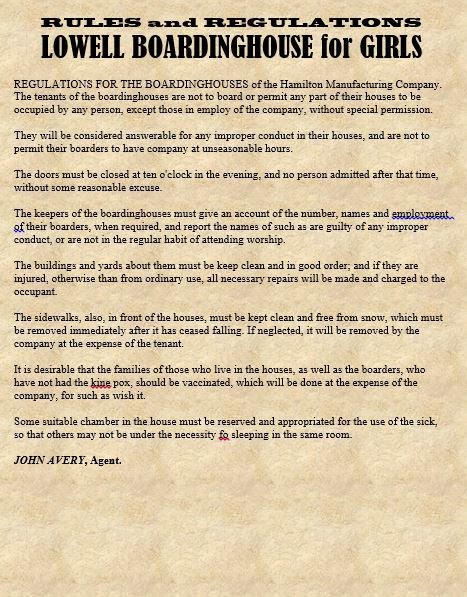
Like in the Roanoke assignment, I compiled a dossier of documents from the time period including rule sheets for the employees of the mills and the boardinghouses where the girls lived. Students read a government report into health concerns of mill employees, as well as a letter based on the description of the mills in the historical fiction novel for young adults, Lyddie by Katherine Paterson. I was also able to find an authentic rule sheet for both the factory and the boardinghouse that would have been distributed to workers. I retyped it and laminated it for the students to peruse.
After reading through the dossier, the students compiled a three-column chart of notes. Once they have the initial information, the teacher can really guide this lesson into any assignment or skill-building exercise that the curriculum requires. Because there is so much flexibility in how these documents can be used and indeed I have used them differently throughout the years, I have posted images of my typed versions of the documents for classroom use. For copyright reasons, I will allow teachers to choose their own excerpts from Lyddie.
A complete transcript of this report can also be found on the University of Massachusetts, Lowell's library site here.
More primary source text from the Lowell mills can also be found here.
Friday, January 9, 2015
Classroom Performers
If you follow this blog at all, you know that much of my inspiration often comes from stories heard on NPR. This post is no exception. Recently, while running errands in the afternoon, I heard a story on All Things Considered about "teachers as performers" and the disparity between this reality and the extent to which we prepare teachers for this role in college and other degree programs.
In the story, teacher Amanda Siepiola describes channeling Bruce Springsteen and his seemingly effortless way of capturing a crowd of thousands. The story goes on to discuss the extent to which good teachers are not only fluent in curriculum, pedagogy, and content material, but also in performing.
This story struck me for three primary reasons. Firstly, I come from a family with more than a few devoted Bruce Springsteen fans. I have also felt many times that there was an element of performance and 'art' to the way that I teach, so the message of this story struck a chord. Finally, I felt a little more connected to this article since Bruce Lenthall, the executive director of the Center for Teaching and Learning at the University of Pennsylvania, was a professor of mine back when he was a visiting history lecturer at Bryn Mawr College.
Particularly in the comments section of the webpage for the story, many seem to have too literal an understanding of what exactly it is like and feels like to be both the "performer" and the student in the performance. Firstly, there is an implication in both the story and the comments that performances are one-way directional experiences and that, as a result, in order to consider a teacher a performer, we must be referring to a lecture-based, teacher-centered classroom. I don't believe that this really needs to be the case.
Speaking to this point, the example of Springsteen is particularly apt. When you see Springsteen, you don't watch him in wonder. He does more than just entertain you; you are part of the show. Otherwise reserved people can be seen dancing in the aisles. Fans bring posters with hundreds of non-Springsteen song titles, essentially challenging him and the E-Street Band to an impromtu jam session of Jackie Wilson's "Higher and Higher" or even "Santa Claus is Coming to Town." The audience watches Bruce and he plans the basic trajectory of the show, but the show changes based on the crowd and the location and the guidance of the audience.
Above is a photo, albeit a crummy cell phone picture, of a Springsteen show that I attended in 2012. It was his last ever show at Philadelphia's Spectrum before it was demolished, a fact that only added to the personal nature of the show. Bruce has banners emblazoned with his record-breaking number of sell-outs at the venue right along side retired player numbers. During each show, the house lights are turned on and the crowd is reminded that they are surrounded by "a few thousand of their closest friends." Minutes after this picture was taken, Bruce was running through the crowd, bringing fans on stage, and playing requests right from the crowd.
Perhaps this is a better description of the performance aspect of teaching. Outside the small minority of purely student-driven, inquiry-based classrooms (which also have their limitations as discussed here), the teacher brings a particular set of skills, experiences, and/or knowledge and guides the trajectory of the course based on specific curriculum and standards. The teacher's role is also not just to keep the kids "entertained," but also to engage and inspire.
Indeed even if a teacher does decide to embrace a methodology that shies away from lecture- or teacher-based instruction, it is clear that his or her enthusiasm will add interest and authenticity to the lesson, and perhaps this is just as much the so-called performance of teaching. Maybe the better question is, what does teaching look like without some aspect of performance? Regardless of the well-planned nature of the lesson or the background knowledge of the teacher, are these the lessons students view as 'boring?'
One thing is for sure -- teaching for me sure feels like a performance. I have spent time with my fair share of musicians given that my husband plays in a local metal band. These musicians often describe a unique feeling of performing that provides a heady feeling of accomplishment, but after the rush of wrapping up the show, they're wiped. This is in essence the late-night version of my teaching life.
When I do what I do, I feel absolutely in my element, like words and ideas are just flowing from me and I feel energized. As soon as the day is over, however, and I decompress and check emails, I am exhausted. And I don't think I am alone in this feeling. Being on is tiring and sharing your energy and creativity really takes it out of you.
For what it's worth, give yourself some credit! Here's to your inner-rockstar!
In the story, teacher Amanda Siepiola describes channeling Bruce Springsteen and his seemingly effortless way of capturing a crowd of thousands. The story goes on to discuss the extent to which good teachers are not only fluent in curriculum, pedagogy, and content material, but also in performing.
This story struck me for three primary reasons. Firstly, I come from a family with more than a few devoted Bruce Springsteen fans. I have also felt many times that there was an element of performance and 'art' to the way that I teach, so the message of this story struck a chord. Finally, I felt a little more connected to this article since Bruce Lenthall, the executive director of the Center for Teaching and Learning at the University of Pennsylvania, was a professor of mine back when he was a visiting history lecturer at Bryn Mawr College.
Particularly in the comments section of the webpage for the story, many seem to have too literal an understanding of what exactly it is like and feels like to be both the "performer" and the student in the performance. Firstly, there is an implication in both the story and the comments that performances are one-way directional experiences and that, as a result, in order to consider a teacher a performer, we must be referring to a lecture-based, teacher-centered classroom. I don't believe that this really needs to be the case.
Speaking to this point, the example of Springsteen is particularly apt. When you see Springsteen, you don't watch him in wonder. He does more than just entertain you; you are part of the show. Otherwise reserved people can be seen dancing in the aisles. Fans bring posters with hundreds of non-Springsteen song titles, essentially challenging him and the E-Street Band to an impromtu jam session of Jackie Wilson's "Higher and Higher" or even "Santa Claus is Coming to Town." The audience watches Bruce and he plans the basic trajectory of the show, but the show changes based on the crowd and the location and the guidance of the audience.
Above is a photo, albeit a crummy cell phone picture, of a Springsteen show that I attended in 2012. It was his last ever show at Philadelphia's Spectrum before it was demolished, a fact that only added to the personal nature of the show. Bruce has banners emblazoned with his record-breaking number of sell-outs at the venue right along side retired player numbers. During each show, the house lights are turned on and the crowd is reminded that they are surrounded by "a few thousand of their closest friends." Minutes after this picture was taken, Bruce was running through the crowd, bringing fans on stage, and playing requests right from the crowd.
Perhaps this is a better description of the performance aspect of teaching. Outside the small minority of purely student-driven, inquiry-based classrooms (which also have their limitations as discussed here), the teacher brings a particular set of skills, experiences, and/or knowledge and guides the trajectory of the course based on specific curriculum and standards. The teacher's role is also not just to keep the kids "entertained," but also to engage and inspire.
Indeed even if a teacher does decide to embrace a methodology that shies away from lecture- or teacher-based instruction, it is clear that his or her enthusiasm will add interest and authenticity to the lesson, and perhaps this is just as much the so-called performance of teaching. Maybe the better question is, what does teaching look like without some aspect of performance? Regardless of the well-planned nature of the lesson or the background knowledge of the teacher, are these the lessons students view as 'boring?'
One thing is for sure -- teaching for me sure feels like a performance. I have spent time with my fair share of musicians given that my husband plays in a local metal band. These musicians often describe a unique feeling of performing that provides a heady feeling of accomplishment, but after the rush of wrapping up the show, they're wiped. This is in essence the late-night version of my teaching life.
When I do what I do, I feel absolutely in my element, like words and ideas are just flowing from me and I feel energized. As soon as the day is over, however, and I decompress and check emails, I am exhausted. And I don't think I am alone in this feeling. Being on is tiring and sharing your energy and creativity really takes it out of you.
For what it's worth, give yourself some credit! Here's to your inner-rockstar!
Tuesday, January 6, 2015
Have you checked out Understood?
Understood is really intended as a resource for parents of students with learning differences, but it can be tremendously helpful for teachers, as well.
The site has information about learning disabilities, simulations to "see the world through your child's eyes," and tools and forums for parents. They offer an email newsletter that provides frequent updates about new material.
To illustrate how this can be useful for teachers, today's email update featured reviews of apps that are useful for students with various learning problems and attention issues. The slideshow is featured here.
Reaching students with learning and attention issues can be challenging, especially for the many teachers who are so-called neurotypical and have never experienced these problems. Understood is a great resource for understanding the way children learn and reaching out to others in the community for support and strategies.
The site has information about learning disabilities, simulations to "see the world through your child's eyes," and tools and forums for parents. They offer an email newsletter that provides frequent updates about new material.
To illustrate how this can be useful for teachers, today's email update featured reviews of apps that are useful for students with various learning problems and attention issues. The slideshow is featured here.
Reaching students with learning and attention issues can be challenging, especially for the many teachers who are so-called neurotypical and have never experienced these problems. Understood is a great resource for understanding the way children learn and reaching out to others in the community for support and strategies.
Tuesday, December 2, 2014
It's Club Season!
Now that the winter session is upon us, it is time for the winter club season here at our school! Over the next few weeks, I will be posting about some activities from my two clubs, the Middle School Art Club and the Middle and Upper School Comics and Gaming Club.
These projects can be easily adapted for students in regular art classes, as well as for teachers using comics and graphic novels in literature and content area courses. This is my first time running these particular clubs so I am excited to get started!
Keep on the lookout for the following upcoming activities:
Rope Bowls
Silhouette Paintings with Masking Technique
Stamped Clay Plates
Basic Jewelry Making
Creating Comics with Pixton Software
Making Superheroes with Marvel Site
Fantasy Board and Card Gaming
These projects can be easily adapted for students in regular art classes, as well as for teachers using comics and graphic novels in literature and content area courses. This is my first time running these particular clubs so I am excited to get started!
Keep on the lookout for the following upcoming activities:
Rope Bowls
Silhouette Paintings with Masking Technique
Stamped Clay Plates
Basic Jewelry Making
Creating Comics with Pixton Software
Making Superheroes with Marvel Site
Fantasy Board and Card Gaming
Monday, December 1, 2014
Washington Crosses the Delaware
Throughout my course, I find that I always want to teach a common tension throughout the entire field of historical scholarship -- understanding and familiarity with the accepted iconography and narrative, while also teaching an undertone of critical questioning into that narrative. I have found one example of that tension to be in Emanuel Leutze's iconic painting, Washington Crosses the Delaware. (Henry Wadsworth Longfellow's Paul Revere's Ride is another great example.)
For this lesson, I wanted to teach the event and familiarize students with the famous image of a stoic Washington braving the ice and snow in a surprise attack on Trenton while also discussing some of the context of the painting itself. For the first objective, we would reenact the painting. We spent some time creating some simple props for the scene, such as oars made from dollar store brooms, a boat made of posterboard propped up by crates, and assembling some costumes with everything from three-cornered hats to scarves and bedsheets.
The goal of this re-enactment was two-fold. Firstly, I wanted students to be familiar with the iconic image of Washington Crossing the Delaware. After completing this re-enactment, students found several examples of parodies and other images that used the recognizable icon including everything from the video game Assassin's Creed to My Little Pony.
Secondly, I wanted students to analyze how these images become part of the American memory and how they reflect popular themes in American memory and mythos. In a wrap-up written assignment after the simulation, we read into further detail about some inaccuracies in the painting and to what extent these were the artist's intentional creative license.
For this lesson, I wanted to teach the event and familiarize students with the famous image of a stoic Washington braving the ice and snow in a surprise attack on Trenton while also discussing some of the context of the painting itself. For the first objective, we would reenact the painting. We spent some time creating some simple props for the scene, such as oars made from dollar store brooms, a boat made of posterboard propped up by crates, and assembling some costumes with everything from three-cornered hats to scarves and bedsheets.
The goal of this re-enactment was two-fold. Firstly, I wanted students to be familiar with the iconic image of Washington Crossing the Delaware. After completing this re-enactment, students found several examples of parodies and other images that used the recognizable icon including everything from the video game Assassin's Creed to My Little Pony.
Secondly, I wanted students to analyze how these images become part of the American memory and how they reflect popular themes in American memory and mythos. In a wrap-up written assignment after the simulation, we read into further detail about some inaccuracies in the painting and to what extent these were the artist's intentional creative license.
Finally, each student got a color printout of the picture from their class as a keepsake -- and they really loved this part! I have included one of the photos below with the students' faces blurred. Try this one out! It's a great one and makes for fantastic yearbook pictures!
Sunday, November 16, 2014
Scootin' for Newton
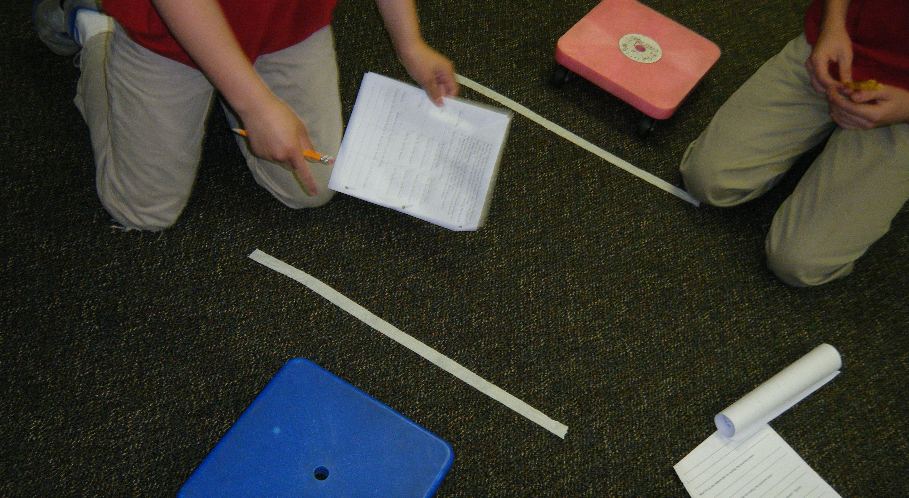
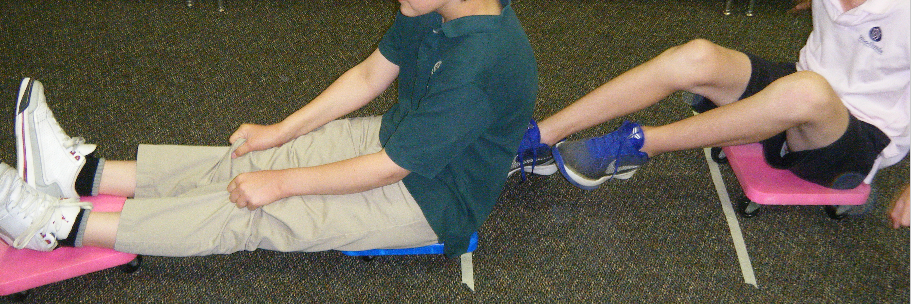
This week, I made my annual visit deep into the back of the P.E. closet to pull out the old scooters. It's Newton time again. While covering Newton's three laws of motion, we try to demonstrate each of the laws in class, and this demo works really well for Newton's third law.
It was really refreshing to revisit this demonstration since making the swap to 7th and 8th grade social studies two years ago. For the past year, I have been working on a special education certification and a second Master's degree in the field. My recent course had me revisiting math and science instruction, so I took a little break from my usual history-based routine to teach this lesson. I am editing this post to include some pictures from that demonstration.
For further information about how to conduct this lab, as well as some images of our lab sheets, check out my post from May 2011.
Here are some fun pictures from today:
It was really refreshing to revisit this demonstration since making the swap to 7th and 8th grade social studies two years ago. For the past year, I have been working on a special education certification and a second Master's degree in the field. My recent course had me revisiting math and science instruction, so I took a little break from my usual history-based routine to teach this lesson. I am editing this post to include some pictures from that demonstration.
For further information about how to conduct this lab, as well as some images of our lab sheets, check out my post from May 2011.
Here are some fun pictures from today:
Friday, March 21, 2014
Keep or Toss?
What can reality shows on television and the "real food" movement teach us about the future of education? It may seem like a stretch, but in reading some of the most recent writing out there about radical new teaching techniques, there may be some parallels worth considering.
You've probably seen those reality shows on TV in which a team of energetic people, usually in matching shirts, sweep into someone's house and clean it out. They sort through all of the clutter and then introduce a system of plastic bins and printed labels to reorganize a person's life. In at least a few iterations of these shows, there is always a series of tarps out on the front lawn for sorting objects labeled "keep" and "toss."
It seems to me that the world is immersed in a massive paradigm shift into a data- and computer-driven age and we are constantly re-evaluating how we interact with each other. Similarly, education, parenting and child development seems to be going through a similar shift -- a metaphorical "keep or toss" of traditional techniques. While it is impossible to ignore the differences in the way that today's young people interact with their world and each other, I sometimes wonder if too much of what we know as "good teaching" is going into the "toss" pile in favor of more free-form, inquiry-driven and high-tech practices.
The rapid pace of change in today's youth is particularly evident to me as a relatively young teacher. Sure, it has been commonplace for decades for adults to see huge differences in the way that young people use technology and behave socially, but to see such a dramatic change in less than one generation is a new phenomenon. It seems like the changes between generations are increasing at an exponential pace.
To acknowledge that this is happening is one thing, but should we fully embrace the way that young people are evolving as 100% inevitable and valuable? What is the perfect balance of what to "keep" and what to "toss?" What happens when too much is "tossed?"
There is no question that students are more successful and more likely to understand and retain information that is presented in a connected and creative way and that is relevant and based in student inquiry. This has been the primary push in educational research and teacher instruction for decades. In just my own career, however, of studying and practicing the art of teaching, this concept has broadened to the extent that much of education writing suggests throwing the entire school paradigm out the window in favor of technology-based student-guided projects and research into topics of exclusively their own choosing. An exemplary article describing this type of movement is this one from Wired.
So this leads me back to the keep piles and toss piles. When our culture largely moved past lecture-based teaching with massive class sizes, I was on board. When we tossed out student shaming as a means of discipline, it was for the better. Several aspects of traditional teaching have been put in the "toss" pile over the years and this was a necessary shift, if a slow one at times.
Even in my relatively young perspective, we seem to be standing at the precipice of putting an awful lot of stuff into the "toss" pile. I am worried that we may not value enough the parts of today's teaching that maybe should remain in the "keep."
The adults in my life have exposed me to subjects and ideas that I may never have discovered without them. They have provided insight into life experiences. They have shared their histories with me. I have also learned arts and skills that may be obsolete, but incredibly enjoyable. As I tell my students all the time, even if a skill or a tidbit of knowledge doesn't affect their lives directly, it puts a little wrinkle into their grey matter and makes them a more well-rounded person and a better thinker.
That said, I don't know if I am ready to give all of this adult input up to embrace a completely student-driven paradigm. And there are plenty of educational think tanks and writers out there would have me feel pretty guilty and entitled about making that statement. I may sound like I am overstating the recent push toward student inquiry, but
Lately, I have been reading through Michael Pollan's body of work about food. I have read Cooked and The Omnivore's Dilemma, but his book that really struck a chord with me recently was In Defense of Food: An Eater's Manifesto. The primary thread of the argument is that we as a society need to return to the "real food" of our grandparents' generation. Most of society embraced an industrial food model as the way of the future, as modern and empowering. Women were no longer required to spend countless hours in the home preparing foods by traditional means and other technologies, most notably television, became part of meal time experience.
Initially, this was perceived as the wave of the future, the inevitable march toward progress. Now, however, many deeply regret this transition. The American population is heavier than ever and while our expected lifespan is longer, we are suffering and dying from diet-related health conditions more than ever. Pollan quite convincingly argues that the processed versions of food are never as nutritious as the "real food," and we are paying the price in our mental and physical health. In addition, research has shown that the simple act of eating meals together makes for happier families, healthier diets and even lower rates of drug use and suicide in young people. In this case, the tech-driven wave of the future seems to have provided some progress -- like movement toward gender equality and wider food options -- but also has led us astray.
Why bring up this example of food? Today, the biggest movement in the world of culinaria is one that looks backward to an earlier time instead of toward the future. Locally-sourced and seasonal foods, organic agriculture, and "slow food" are the buzzwords of a culture that has found something wrong and downright dangerous in the quick and unquestioning embrace of how new technology changes ancient and essential human activities. As it turns out, cooking food and sharing it with our families at meal time was pretty darn important. Further, the legacy of our prior generations had something to teach us and it turned out to be really valuable.
I am worried that too quick of a jump into the "future of teaching" and fully embracing technology and the "connectedness" of today's socially-networked society might just be a repeat of the TV dinners and fast food of the last generation. Simply put, the needs and operations of the human mind may not evolve as quickly as our technologies do.
In no way am I arguing that technology should not be part of classroom instruction. As a matter of fact, ours is a very high-tech school and we are finding that assistive technologies like text-to-speech software, teacher websites and visual graphic generators are an important part of our instruction and I have blogged about several of them here, here, here and here, among many other posts. Instead, I hope to merely raise the question of how much is too much to "toss."
Students are exposed to new skills, topics and ideas through the expertise and experiences of the adults in their lives. Learning from adults in order to grow into adults is the quintessential part of youth and adolescence throughout all of human history. While it has been valuable to consider student inquiry, embrace young ingenuity and nourish the experience of childhood, it may be taking it too far when we flip the system on its head and only value the insight and motivation of young people. You can call it self-preservation or an inflated sense of purpose, but I do believe that I have something valuable to offer my students in my life of knowledge and experience, and I think most of them would be inclined to agree.
You've probably seen those reality shows on TV in which a team of energetic people, usually in matching shirts, sweep into someone's house and clean it out. They sort through all of the clutter and then introduce a system of plastic bins and printed labels to reorganize a person's life. In at least a few iterations of these shows, there is always a series of tarps out on the front lawn for sorting objects labeled "keep" and "toss."
It seems to me that the world is immersed in a massive paradigm shift into a data- and computer-driven age and we are constantly re-evaluating how we interact with each other. Similarly, education, parenting and child development seems to be going through a similar shift -- a metaphorical "keep or toss" of traditional techniques. While it is impossible to ignore the differences in the way that today's young people interact with their world and each other, I sometimes wonder if too much of what we know as "good teaching" is going into the "toss" pile in favor of more free-form, inquiry-driven and high-tech practices.
The rapid pace of change in today's youth is particularly evident to me as a relatively young teacher. Sure, it has been commonplace for decades for adults to see huge differences in the way that young people use technology and behave socially, but to see such a dramatic change in less than one generation is a new phenomenon. It seems like the changes between generations are increasing at an exponential pace.
To acknowledge that this is happening is one thing, but should we fully embrace the way that young people are evolving as 100% inevitable and valuable? What is the perfect balance of what to "keep" and what to "toss?" What happens when too much is "tossed?"
There is no question that students are more successful and more likely to understand and retain information that is presented in a connected and creative way and that is relevant and based in student inquiry. This has been the primary push in educational research and teacher instruction for decades. In just my own career, however, of studying and practicing the art of teaching, this concept has broadened to the extent that much of education writing suggests throwing the entire school paradigm out the window in favor of technology-based student-guided projects and research into topics of exclusively their own choosing. An exemplary article describing this type of movement is this one from Wired.
So this leads me back to the keep piles and toss piles. When our culture largely moved past lecture-based teaching with massive class sizes, I was on board. When we tossed out student shaming as a means of discipline, it was for the better. Several aspects of traditional teaching have been put in the "toss" pile over the years and this was a necessary shift, if a slow one at times.
Even in my relatively young perspective, we seem to be standing at the precipice of putting an awful lot of stuff into the "toss" pile. I am worried that we may not value enough the parts of today's teaching that maybe should remain in the "keep."
The adults in my life have exposed me to subjects and ideas that I may never have discovered without them. They have provided insight into life experiences. They have shared their histories with me. I have also learned arts and skills that may be obsolete, but incredibly enjoyable. As I tell my students all the time, even if a skill or a tidbit of knowledge doesn't affect their lives directly, it puts a little wrinkle into their grey matter and makes them a more well-rounded person and a better thinker.
That said, I don't know if I am ready to give all of this adult input up to embrace a completely student-driven paradigm. And there are plenty of educational think tanks and writers out there would have me feel pretty guilty and entitled about making that statement. I may sound like I am overstating the recent push toward student inquiry, but
Lately, I have been reading through Michael Pollan's body of work about food. I have read Cooked and The Omnivore's Dilemma, but his book that really struck a chord with me recently was In Defense of Food: An Eater's Manifesto. The primary thread of the argument is that we as a society need to return to the "real food" of our grandparents' generation. Most of society embraced an industrial food model as the way of the future, as modern and empowering. Women were no longer required to spend countless hours in the home preparing foods by traditional means and other technologies, most notably television, became part of meal time experience.
Initially, this was perceived as the wave of the future, the inevitable march toward progress. Now, however, many deeply regret this transition. The American population is heavier than ever and while our expected lifespan is longer, we are suffering and dying from diet-related health conditions more than ever. Pollan quite convincingly argues that the processed versions of food are never as nutritious as the "real food," and we are paying the price in our mental and physical health. In addition, research has shown that the simple act of eating meals together makes for happier families, healthier diets and even lower rates of drug use and suicide in young people. In this case, the tech-driven wave of the future seems to have provided some progress -- like movement toward gender equality and wider food options -- but also has led us astray.
Why bring up this example of food? Today, the biggest movement in the world of culinaria is one that looks backward to an earlier time instead of toward the future. Locally-sourced and seasonal foods, organic agriculture, and "slow food" are the buzzwords of a culture that has found something wrong and downright dangerous in the quick and unquestioning embrace of how new technology changes ancient and essential human activities. As it turns out, cooking food and sharing it with our families at meal time was pretty darn important. Further, the legacy of our prior generations had something to teach us and it turned out to be really valuable.
I am worried that too quick of a jump into the "future of teaching" and fully embracing technology and the "connectedness" of today's socially-networked society might just be a repeat of the TV dinners and fast food of the last generation. Simply put, the needs and operations of the human mind may not evolve as quickly as our technologies do.
In no way am I arguing that technology should not be part of classroom instruction. As a matter of fact, ours is a very high-tech school and we are finding that assistive technologies like text-to-speech software, teacher websites and visual graphic generators are an important part of our instruction and I have blogged about several of them here, here, here and here, among many other posts. Instead, I hope to merely raise the question of how much is too much to "toss."
Students are exposed to new skills, topics and ideas through the expertise and experiences of the adults in their lives. Learning from adults in order to grow into adults is the quintessential part of youth and adolescence throughout all of human history. While it has been valuable to consider student inquiry, embrace young ingenuity and nourish the experience of childhood, it may be taking it too far when we flip the system on its head and only value the insight and motivation of young people. You can call it self-preservation or an inflated sense of purpose, but I do believe that I have something valuable to offer my students in my life of knowledge and experience, and I think most of them would be inclined to agree.
Artifacts from the Lewis and Clark Expedition
Once again, our textbook zips through another historical event that I felt deserved more attention, so we supplemented the text with a film and a project. I wanted my students to understand just how unknown and expansive the western frontier was during the earliest years of the United States. To say that the country was growing at an unparalleled rate is an understatement. During the Jefferson Administration, the country doubled in size with the Louisiana Purchase and the population nearly tripled. In order to explore and document this new territory, Jefferson appointed Meriwether Lewis and William Clark to traverse the terrain.
The fact that Jefferson still sought to find a Northwest Passage shows how little was known of the new territory. To explore the journey further, we watched National Geographic's production of Lewis & Clark: Great Journey West in class. In the film, we know that there were several goals of the expedition, but among them were to build friendly relations with Native Americans while also formally annexing their lands, but also documenting and mapping what they see and collecting artifacts of the people, animals and natural environment. According to this historical blog, many of these artifacts were dispersed and lost over time.
For our project, students used information from the text, the video and their own research to create their own "artifacts" that may have been lost. For example, it is known that Lewis and Clark spent a significant amount of time with the Mandan people of the Plains and brought back a buffalo hide depicting a battle scene. Several groups created buffalo hides depicting other scenes from the expedition using paper grocery bags. Others created journals with tales from the expedition and included leaves and bone fragments of species previously unknown.
I like this project for a few reasons:
The fact that Jefferson still sought to find a Northwest Passage shows how little was known of the new territory. To explore the journey further, we watched National Geographic's production of Lewis & Clark: Great Journey West in class. In the film, we know that there were several goals of the expedition, but among them were to build friendly relations with Native Americans while also formally annexing their lands, but also documenting and mapping what they see and collecting artifacts of the people, animals and natural environment. According to this historical blog, many of these artifacts were dispersed and lost over time.
For our project, students used information from the text, the video and their own research to create their own "artifacts" that may have been lost. For example, it is known that Lewis and Clark spent a significant amount of time with the Mandan people of the Plains and brought back a buffalo hide depicting a battle scene. Several groups created buffalo hides depicting other scenes from the expedition using paper grocery bags. Others created journals with tales from the expedition and included leaves and bone fragments of species previously unknown.
I like this project for a few reasons:
- The students really enjoy any opportunity to use art and creativity. There are countless benefits to using technology in the classroom, but they really appreciate times when we power down the laptops and create something with just our hands and some art supplies.
- Creating these artifacts made students step back and think about how historical narratives like the textbook are created based on artifacts and other primary sources.
- Looking at the artifacts also forced students to reflect on the ways that our knowledge of our world was built. Only recently have we been able to map and observe our world with satellites, sonar and similar technologies. For most of human history, our collective knowledge of the world came from on-the-ground human exploration and experience.
For the project, students were allowed to create journals, samples, maps and other types of artifact evidence from the trip. They looked at online catalogs of real artifacts and watched a film that reenacted the journey to collect information, then began creating.
They made Mandan buffalo hides depicting famous battles and encounters, journals with leaf samples of real species from the west, as well as recreations of antique maps that showed the journey.
I found this project to be relatively flexible as far as timing and ability levels. Some students got really creative and researched more information about what Lewis and Clark actually collected. Others stayed very concrete and created maps or wrote journal entries. It was also fairly simple to adapt the requirements in order to accommodate shorter time periods as needed.
Thursday, December 12, 2013
Electoral College Simulation
Our next topic after exploring the Articles of Confederation and Constitutional Convention was Washington's presidency. Our textbook briefly describes how Washington was chosen by the Electoral College, but goes into little detail about what this was. I decided that we needed to dig deeper into this question and not only explore how the Electoral College functions today, but how it was originally designed. In the first few elections in American history, the president was not determined by a popular vote, but exclusively by the Electoral College.
First, we discussed the role of the electors as they were originally described. Because the American population at the time was often rural and far-flung and long distance communication was slow to say the least, campaigning was exceedingly difficult. Many Framers also didn't have much faith in the ability of the general populace to chose a worthy candidate for various reasons. To gather information about this particular era of the Electoral College, we watched videos and read from various sources, including The United States Constitution: A Round Table Comic by Nadja Baer. The graphic novel offers a clear, concise and visually-supported version of the events of the Constitutional Convention.
Later, we discussed the election of 1800 and how several key flaws were discovered in the electoral system. Finally, we compared the way the college functions today to the original design on a Venn diagram after watching the following video showing the official process.
To model the electoral process as it is conducted today, we created a mock election in which the entire middle school would participate. We created two mock candidates who represented Federalist and Democratic-Republican agendas. We chose these two political parties because of their significance during the period of history we were studying, but the lesson could easily be adapted to any two or more political parties.
Several of the classes in the middle school were not studying this subject, so our ballots clearly explained the platforms of each candidate. Each homeroom was allowed to vote for a candidate and in our simulation, each homeroom would count as a state with a different number of electoral votes based on population. Before handing out the ballots to each homeroom, we created a fact sheet (shown below) with the electoral votes for each homeroom and a map to color in red and blue as the votes are tallied. The map is intended to look like our middle school hallway and resemble the United States maps that are color-coded during election coverage
After the election, I showed a video of typical news coverage from YouTube of the 2008 election of Barack Obama and Mitt Romney. I showed and explained how the media outlets use a complex algorithm of votes counted, exit polls, historical context and other data to project a winner for each state. Sometimes the winners are called in short order while others may continue to be counted late into the evening or even the following weeks.
Similar to the news reporting on the election, teams of students were allowed to count the votes for each "state," then "call" a state for a particular candidate when the votes were tallied. As the states were called, we kept a school map, like the one shown above, of the hallway and shaded in the homerooms either red or blue depending on the victorious candidate. Finally, when the "magic number" of electoral votes had been assigned to a candidate, we called the election. Later on, each student acted as an elector for a particular state and signed off on a certificate like the ones shown in the electoral college video above.
After our rallies complete with "state" paddles and signing the certificates, I felt that students had a much deeper understanding of how the modern Electoral College system operates and how it has changed over time.
After the election, I showed a video of typical news coverage from YouTube of the 2008 election of Barack Obama and Mitt Romney. I showed and explained how the media outlets use a complex algorithm of votes counted, exit polls, historical context and other data to project a winner for each state. Sometimes the winners are called in short order while others may continue to be counted late into the evening or even the following weeks.
Similar to the news reporting on the election, teams of students were allowed to count the votes for each "state," then "call" a state for a particular candidate when the votes were tallied. As the states were called, we kept a school map, like the one shown above, of the hallway and shaded in the homerooms either red or blue depending on the victorious candidate. Finally, when the "magic number" of electoral votes had been assigned to a candidate, we called the election. Later on, each student acted as an elector for a particular state and signed off on a certificate like the ones shown in the electoral college video above.
After our rallies complete with "state" paddles and signing the certificates, I felt that students had a much deeper understanding of how the modern Electoral College system operates and how it has changed over time.
Thursday, December 5, 2013
The Weakest Link
In discussing the forming of this new nation, the United States, I wanted students to understand why the Articles of Confederation failed, but also why the features that made it weak were built in. I wanted them to see the fears of the Framers about their experiences with British government replaced with new laws, limitations and procedures in the Articles. Finally, I wanted them to analyze what they felt was the weakest part of the plan, or the weakest link.
In order to accomplish the bold, challenging concept, we created a chain of weaknesses in the Articles that led to everything from excessively high state taxes to massive inflation. Chains are easy to create both by hand and on the computer. I wrote about using chains to demonstrate metaphors in a novel here.
In Microsoft Word, you can simply insert a one-column table with as many rows as links. By choosing a larger font or inserting spaces, the rows can be larger and allow for typing or handwriting. These rows can later be cut into strips, then curled and taped into the chains. My students used a template like the one below then typed in the weaknesses.
Students were required to choose five weaknesses based on our in-class discussion. Once the template was complete, we printed them and created chains. Students then had to choose one of the weaknesses that they felt was the most damaging or was the greatest influence on the eventual demise of the Articles. They wrote paragraphs about the so-called "weakest link."
One student had the idea of posting the paragraphs onto images of locks. One of our sources described how some of the features of the Articles "gridlocked" the government, rendering it powerless to levy taxes, regulate trade, or create a standard currency. Using the lock template, we attached the cut-out lock image to the link representing the student's selected "weakest link."
In order to accomplish the bold, challenging concept, we created a chain of weaknesses in the Articles that led to everything from excessively high state taxes to massive inflation. Chains are easy to create both by hand and on the computer. I wrote about using chains to demonstrate metaphors in a novel here.
In Microsoft Word, you can simply insert a one-column table with as many rows as links. By choosing a larger font or inserting spaces, the rows can be larger and allow for typing or handwriting. These rows can later be cut into strips, then curled and taped into the chains. My students used a template like the one below then typed in the weaknesses.
Students were required to choose five weaknesses based on our in-class discussion. Once the template was complete, we printed them and created chains. Students then had to choose one of the weaknesses that they felt was the most damaging or was the greatest influence on the eventual demise of the Articles. They wrote paragraphs about the so-called "weakest link."
One student had the idea of posting the paragraphs onto images of locks. One of our sources described how some of the features of the Articles "gridlocked" the government, rendering it powerless to levy taxes, regulate trade, or create a standard currency. Using the lock template, we attached the cut-out lock image to the link representing the student's selected "weakest link."
Understanding why an entire system of government failed can be daunting, but I found that this helped to break down the Articles into manageable chunks, then allowed students to analyze those weaknesses.
Friday, October 25, 2013
Photo Graphic Novels
There's a whole bunch of research out there suggesting how effective graphic novels can be effective at increasing comprehension, especially for struggling readers and those with dyslexia. But what if a suitable graphic novel doesn't exist for your particular subject matter? Or what if you have a particularly active group of learners who would benefit from a more kinesthetic lesson?
We have had a lot of fun this year with photo re-enactments and transforming those re-enactments into graphic novel-style frames with quotes and captions only enhances student understanding.
Earlier this year, my 8th grade classes analyzed Emmanuel Leutze's iconic painting, Washington Crossing the Delaware. We looked at the historical inaccuracies in the painting, as well as the symbolism that the artist sought to depict. Finally, we created a stand-up "boat" and ice chunks with some painted poster board, oars cut from cardboard and some costume hats and accessories. Students posed "in" the boat in front of a piece of large blue bulletin board paper painted with clouds and light similar to the original. The students really enjoyed this activity and seemed to really connect with the material. So, next time with another class, I took it a step further.
Later on, a different group of 8th graders used a storyboard template worksheet to plan five different scenes of the Capture of Fort Ticonderoga. For each scene, students sketched the poses, planned the props they needed and assigned character roles to each member of the group. I required that the scenes be planned in detail so that on shooting day, each group was only allotted 10 minutes for each scene.
To conclude the activity, I imported the photos into a Word document and framed each picture with a black border. As a class, we added captions, thought bubbles and quote bubbles to each of the scenes using the pre-formatted shapes in the "Insert" ribbon of Word.
We have had a lot of fun this year with photo re-enactments and transforming those re-enactments into graphic novel-style frames with quotes and captions only enhances student understanding.
Earlier this year, my 8th grade classes analyzed Emmanuel Leutze's iconic painting, Washington Crossing the Delaware. We looked at the historical inaccuracies in the painting, as well as the symbolism that the artist sought to depict. Finally, we created a stand-up "boat" and ice chunks with some painted poster board, oars cut from cardboard and some costume hats and accessories. Students posed "in" the boat in front of a piece of large blue bulletin board paper painted with clouds and light similar to the original. The students really enjoyed this activity and seemed to really connect with the material. So, next time with another class, I took it a step further.
Later on, a different group of 8th graders used a storyboard template worksheet to plan five different scenes of the Capture of Fort Ticonderoga. For each scene, students sketched the poses, planned the props they needed and assigned character roles to each member of the group. I required that the scenes be planned in detail so that on shooting day, each group was only allotted 10 minutes for each scene.
To conclude the activity, I imported the photos into a Word document and framed each picture with a black border. As a class, we added captions, thought bubbles and quote bubbles to each of the scenes using the pre-formatted shapes in the "Insert" ribbon of Word.
(In the image above, the students' faces have been omitted. In the final product, they are visible.)
By acting out the scenes, then coming back and adding captions, I have found that the students have a more complete and retrievable memory of the events. The activity also made for a fun day outside and a very real opportunity to students to take responsibility for making choices about the most important scenes and planning the scenes themselves. We had a great time participating in this activity and as the students get more comfortable with the procedure, it can be easily applied to reading, science and other content areas.
Wednesday, October 16, 2013
Snapshots of Life, or Teaching with Photojournalism
When I was still a young student myself, I remember how much I was struck by the images in Peter Menzel's Materials Worlds photojournalism project. It's a cliche to say that "pictures are worth a thousand words," but in this case, a single image did more to describe everyday life for average families around the world than prose ever could.
I have taught lessons based on these photographs a few times to teach a huge idea that I simply call "worldly thinking." A few years ago, I heard about a similar project by another photographer, James Mollison. His gallery of images shows Where Children Sleep and again, a single image shows the radical disparity between the way different people live from country to country, even from town to town. I was so struck by these complimentary projects, that I blogged about it here on SpenceSpace back in 2011.
Well, I'm back again with another similar project and this time, the uses for the images can be used for "worldly thinking" instruction, but also to discuss nutrition and health. Peter Menzel has started another project, featured here on Nutrition News, showing a week's worth of groceries from various countries around the world.
Some viewers will be affected by the sheer quantities of food in the industrial world versus the simple sacks of grain in the developing countries featured. Others, however, will be struck by the amount of fresh produce in so many homes compared to the piles of processed and prepared foods in Europe and North America. Either way, the images can be used for a host of lessons about culture, food, nutrition, globalism, or just that big notion of "worldly thinking."
As the world continues to become more global, there are still massive disparities between lifestyles around the world. There are few ways to show this better to students than with a series of photographs that do more for their understanding than words or explanation ever could.
I have taught lessons based on these photographs a few times to teach a huge idea that I simply call "worldly thinking." A few years ago, I heard about a similar project by another photographer, James Mollison. His gallery of images shows Where Children Sleep and again, a single image shows the radical disparity between the way different people live from country to country, even from town to town. I was so struck by these complimentary projects, that I blogged about it here on SpenceSpace back in 2011.
Well, I'm back again with another similar project and this time, the uses for the images can be used for "worldly thinking" instruction, but also to discuss nutrition and health. Peter Menzel has started another project, featured here on Nutrition News, showing a week's worth of groceries from various countries around the world.
Some viewers will be affected by the sheer quantities of food in the industrial world versus the simple sacks of grain in the developing countries featured. Others, however, will be struck by the amount of fresh produce in so many homes compared to the piles of processed and prepared foods in Europe and North America. Either way, the images can be used for a host of lessons about culture, food, nutrition, globalism, or just that big notion of "worldly thinking."
As the world continues to become more global, there are still massive disparities between lifestyles around the world. There are few ways to show this better to students than with a series of photographs that do more for their understanding than words or explanation ever could.
Wednesday, May 1, 2013
What if the Patriots had Facebook?
In preparing for our upcoming lesson on colonial upheaval before the American Revolution, I was reading through our textbook and their discussion of the Committee of Correspondence. Just like so many revolutions in recent history, the political activism of the colonial period was spread through social networking.
We discussed how grassroots protest and activism almost always spreads this way during the lesson and many students were aware of the role of Twitter, Facebook and other social networking sites in the fostering of political action today. The Patriots, however, communicated between colonies with a network of letters and express riders up and down the east coast. This discussion got my brain juices flowing...
Any of us who spend a decent amount of time on the web have probably seen fake Facebook walls about everything from TV shows to historical events. One that my family and I recently enjoyed was a spoof of an episode of PBS's Downton Abbey. I thought about how the Patriots would have communicated had they access to Facebook, and I also wondered how this could incorporate their fluency with the medium of social networking and their senses of humor and creativity.
I got to my laptop, opened up my Facebook wall and created a Word template with editable text boxes that looked just like a real Facebook page. I have included an image of the template below, but you can also download the document with the link provided.
View and download the template as a Google doc here.
For our purposes, we created these Facebook farces on 11" x 17" and printed them in color to hang in the hallway. The kids showed off their knowledge of the colonial activists by joining them into groups like the Sons of Liberty and inviting them to events like the Stamp Act Congress. They also added some humor in their interactions between figures and "liking" various slogans, pictures and events.
The potential for these types of projects is endless. This template and the idea could be used for characters in literature, any historical figures, or even more abstract concepts, like personifying geometric shapes or elements from the periodic table. Please feel free to share how you have used Facebooking in your lessons!
We discussed how grassroots protest and activism almost always spreads this way during the lesson and many students were aware of the role of Twitter, Facebook and other social networking sites in the fostering of political action today. The Patriots, however, communicated between colonies with a network of letters and express riders up and down the east coast. This discussion got my brain juices flowing...
Any of us who spend a decent amount of time on the web have probably seen fake Facebook walls about everything from TV shows to historical events. One that my family and I recently enjoyed was a spoof of an episode of PBS's Downton Abbey. I thought about how the Patriots would have communicated had they access to Facebook, and I also wondered how this could incorporate their fluency with the medium of social networking and their senses of humor and creativity.
I got to my laptop, opened up my Facebook wall and created a Word template with editable text boxes that looked just like a real Facebook page. I have included an image of the template below, but you can also download the document with the link provided.
View and download the template as a Google doc here.
For our purposes, we created these Facebook farces on 11" x 17" and printed them in color to hang in the hallway. The kids showed off their knowledge of the colonial activists by joining them into groups like the Sons of Liberty and inviting them to events like the Stamp Act Congress. They also added some humor in their interactions between figures and "liking" various slogans, pictures and events.
The potential for these types of projects is endless. This template and the idea could be used for characters in literature, any historical figures, or even more abstract concepts, like personifying geometric shapes or elements from the periodic table. Please feel free to share how you have used Facebooking in your lessons!
Tuesday, April 23, 2013
Battlefort
In my previous post, I described how fun it can be to recreate games that kids already know with new rules adapted to the curriculum. We did just that again this week with a modified version of Battleship that simulated the conflict during the French and Indian War.
Because the French and Indian War was not a naval battle, I gave each student a grid and allowed them to set it up as they liked. Each student was also assigned a country - either Britain or France. We color-coded each of the squares as either French territory (blue), British territory (red), or disputed territory (purple). Because the grid was an 8 x 8 arrangement of 64 squares, I gave the students the following parameters to keep the game fair:
- You must have 20 blocks of your own color, 20 blocks of the opposing color and 24 blocks of disputed territory.
- You can arrange the blocks in any way as long as the French blocks are all together on one side or corner of the board, the British blocks are all together on the opposite side or corner of the board and the purple disputed blocks are somewhere in the middle.
Also on the grid handout were three forts which were exactly 3 blocks wide and 1 block tall, and two settlements, which were 2 blocks wide and 1 block tall. Once they had finished color-coding the area of the map, they could cut out the forts and settlements and arrange them anywhere within their own or the disputed territory. For a faster set-up of the game, you can also provide the students with pre-colored grids, even labeled with place names and boundaries if you wish.
Now they were ready to play the game! To create the "boards" for the game, I used basic file folders. I set up another identical grid with letter and number coordinates and printed it in the copier on transparency film. I stapled two sheets in each folder - one on the bottom for the students to slide their own grids underneath and a second to the top flap of the folder for keeping track of their own called coordinates, hits and misses.
With the grids printed on transparency film, the students can mark both boards with dry erase markers, eliminating the need for pegs or bingo chips. We simply used Xs for hits and Os for misses. This was a lot neater and made for a lot less preparation!
The final boards looked like the image below. I decided to assign a point value to all possible outcomes to make things a bit more interesting. In our game, we used the following scoring system:
- hit opposing territory (empty square) = 2 pts.
- hit disputed territory (empty square) = 1 pt.
- hit your own territory = 0 pts.
- hit anywhere on a fort = 10 pts.
- hit anywhere on a settlement = 5 pts.
Students kept track of their points on scrap paper or on the margins of the grid in dry erase.
I was pleasantly surprised by how much the kids enjoyed setting up the boards and playing the game. Even though their boards did not exactly imitate the land boundaries of the French and Indian War, the idea of disputed territory certainly stuck with them. I even overheard someone call out at one point, "This must be the Battle of Quebec because I am really kicking your butt!" :)
Monday, April 22, 2013
Flap Maps
Sometimes, to really visualize a territory or battle, you just need a good map. But sometimes, in order to effectively study, you also need to hide your information to really assess your own recall and understanding. As a visualizing tool and a study strategy, we recently made "flap maps" to show the expansion of New Spain into New Mexico and Florida. Using just Microsoft Word, these maps are really easy to make and get the kids moving with some color-coding, cutting and gluing.
In essence, a flap map is just an outline map with titled text boxes scattered around at key points. The students then color-code the map according to a self-made key. I then send them a second document with text boxes in the same arrangement as the titled text boxes on the map page. When the students have finished with the initial sheet, they fill in key facts about each of the named sites. When the fact sheet is printed, it will line up perfectly with the map boxes. The students can then cut out three sides of each text box on the map page.
Once the students have glued the fact sheet to the back of the map page, the map text boxes are now "doors" or "flaps" that can be opened and closed. When opened, the facts from underneath are revealed for studying. The map can also easily fit into student binders and folders for quick reference later!
Below are some images of the Word templates I created, as well as a few pictures of the finished maps.
In essence, a flap map is just an outline map with titled text boxes scattered around at key points. The students then color-code the map according to a self-made key. I then send them a second document with text boxes in the same arrangement as the titled text boxes on the map page. When the students have finished with the initial sheet, they fill in key facts about each of the named sites. When the fact sheet is printed, it will line up perfectly with the map boxes. The students can then cut out three sides of each text box on the map page.
Once the students have glued the fact sheet to the back of the map page, the map text boxes are now "doors" or "flaps" that can be opened and closed. When opened, the facts from underneath are revealed for studying. The map can also easily fit into student binders and folders for quick reference later!
Below are some images of the Word templates I created, as well as a few pictures of the finished maps.
Thursday, April 18, 2013
Pin - the - ?? - on - the - ??
I like incorporating games into classroom instruction and one really easy way to make it transition seamlessly is to use games the students already know.
When reviewing Jacques Marquette and Robert La Salle's exploration of the Mississippi River for France, I wanted an engaging way to review which facts belonged to which explorer. I decided to play a version of Pin-the-Tail-on-the-Donkey with "fact canoes" in place of tails and a Mississippi River with images of the explorers in place of the donkey.
I was a little leery that the kids would find it too juvenile, but we ended up having a blast! I presented each fact and asked the student whether the fact belonged with Marquette or La Salle. They responded, then they were blindfolded, took their spins and attempted to stick the canoe in the river with the explorer that matched.
The set-up was really simple -- I typed up some images of canoes with facts, pictures of the explorers and I cut out a long construction paper river. I attached the pieces to the whiteboard with magnets for easy removal when other teachers needed to use my classroom. The game only lasted about 10-15 minutes, but it was a fun way to wrap up after the notes and video segment we completed at the beginning of class.
Of course, this got me thinking about all of the things that could be "pinned" onto something else. Younger students could sort shapes and colors into a chart. They could place letters in a puzzle. Older students could pin the element to the periodic table or the organelles to the cell. The possibilities are endless!
When reviewing Jacques Marquette and Robert La Salle's exploration of the Mississippi River for France, I wanted an engaging way to review which facts belonged to which explorer. I decided to play a version of Pin-the-Tail-on-the-Donkey with "fact canoes" in place of tails and a Mississippi River with images of the explorers in place of the donkey.
I was a little leery that the kids would find it too juvenile, but we ended up having a blast! I presented each fact and asked the student whether the fact belonged with Marquette or La Salle. They responded, then they were blindfolded, took their spins and attempted to stick the canoe in the river with the explorer that matched.
The set-up was really simple -- I typed up some images of canoes with facts, pictures of the explorers and I cut out a long construction paper river. I attached the pieces to the whiteboard with magnets for easy removal when other teachers needed to use my classroom. The game only lasted about 10-15 minutes, but it was a fun way to wrap up after the notes and video segment we completed at the beginning of class.
Of course, this got me thinking about all of the things that could be "pinned" onto something else. Younger students could sort shapes and colors into a chart. They could place letters in a puzzle. Older students could pin the element to the periodic table or the organelles to the cell. The possibilities are endless!
Alphabet Books: Bringing Together Younger and Older Students
One of the many benefits of teaching in a school with a wide range of ages is the ability to collaborate across many grade levels. Older students are often excited to engage with younger students, just as younger students often look up to their older peers. In order to capture this natural energy and opportunity for community building, I like to create alphabet books each year about a concept or theme, then share them in with younger students either live or through circulation in the library.
This year, I had to cover everyday life during the colonial era, but had much difficulty finding sources, activities and materials appropriately challenging for middle level students. A quick Google search will make it abundantly clear how much of what is out there is for primary students. I figured that I might as well embrace the over-arching trend and use the alphabet book as a final project for this particular section.
I provided the students with several sites about colonial life, most notably PBS's Colonial House materials and Colonial Williamsburg's history site. From there, students refreshed their previous knowledge of colonial occupations (see post about classified ads project), as well as vocabulary terms and concepts. I assigned each student a few letters and they designed a page for each letter, designating a word for each letter. I scattered a few sample alphabet books about countries of the world, musical instruments and science topics around the room just to demonstrate the basic format, then let them go wild.
Between all 48 students, we were able to generate three unique books for the library, each with creative ideas for the letters. Some students tackled more abstract themes, like agriculture and slavery, while others chose figures and events, like Jamestown, John Peter Zenger and the Salem Witch Trials.
I bound the books together with a simple plastic comb binding machine and shared it with the school library. Shortly after, our librarian asked for the electronic files of the pages so that we could attempt converting it into its own ebook! Who knows, maybe younger students will soon be able to check-out our alphabet book both at the library and electronically! If this works well, we might just have a lot a ebook publishing in our future!
This year, I had to cover everyday life during the colonial era, but had much difficulty finding sources, activities and materials appropriately challenging for middle level students. A quick Google search will make it abundantly clear how much of what is out there is for primary students. I figured that I might as well embrace the over-arching trend and use the alphabet book as a final project for this particular section.
I provided the students with several sites about colonial life, most notably PBS's Colonial House materials and Colonial Williamsburg's history site. From there, students refreshed their previous knowledge of colonial occupations (see post about classified ads project), as well as vocabulary terms and concepts. I assigned each student a few letters and they designed a page for each letter, designating a word for each letter. I scattered a few sample alphabet books about countries of the world, musical instruments and science topics around the room just to demonstrate the basic format, then let them go wild.
Between all 48 students, we were able to generate three unique books for the library, each with creative ideas for the letters. Some students tackled more abstract themes, like agriculture and slavery, while others chose figures and events, like Jamestown, John Peter Zenger and the Salem Witch Trials.
I bound the books together with a simple plastic comb binding machine and shared it with the school library. Shortly after, our librarian asked for the electronic files of the pages so that we could attempt converting it into its own ebook! Who knows, maybe younger students will soon be able to check-out our alphabet book both at the library and electronically! If this works well, we might just have a lot a ebook publishing in our future!
Subscribe to:
Posts (Atom)