Wednesday, February 29, 2012

Inspired by Inspiration

Have you checked out the software Inspiration?  It's definitely worth a look.

We are fortunate enough to have this software preloaded on all student and teacher laptops, but many of the kids still do not know how to use it.  Inspiration is a software that allows you to type information into graphic organizers or webs.  There are several different options for these bubbles, as well, including shapes, images, colors and formatting. 

These webs allow students to visually organize information for practice when worksheets or more traditional study methods have become tedious or ineffective.  There are also tons of templates preloaded into the software for common topics in reading, math, science, social studies and music. 

Earlier this week, we tackled the topic of cells, tissues, organs and systems, and to me, this subject matter needs visual organization for it to make sense.  To display this idea, we created webs of six of the human systems (digestive, respiratory, circulatory, muscular, nervous, and skeletal) and mapped out their parts (organs) with images of the cells.  This way, students had an electronic document showing the diverse appearances of different human cells.


We have used these kinds of webs in reading and science with much success.  What is even more exciting, however, are the potentialities for writing.  As long as the web bubbles and links are formatted correctly, Inspiration can take the web and convert it into an outline.  This outline is printable and can also be copied into Microsoft Word for crafting essays and paragraphs.  Get inspired!

Friday, February 24, 2012

Mitosis Virtual Lab

We've already dragged out the microscopes a few times during this cell unit, but it would have been quite a feat to get them out again and find just the right sample with cells in the process of mitosis.  Instead, we conducted a virtual lab online to view actual cells in mitosis and identify the stages. 

As is the routine in all of our labs, students had to maintain a lab packet, follow the scientific method and answer reflective questions, but the inquiry itself was occurring virtually on screen.  Students were provided with a link to Rutgers University's online biology labs and completed Lab #2 on Cell Reproduction. 

During this lab, students viewed a sample of plant cells (onion root tip), as well as animal cells (whitefish blastulae) and identified the stages of mitosis.  They also had to reflect on the differences in the stages in each sample.  Also important, students always must make sketches of what they have seen in order to properly visualize the concept or task at hand, and also to look back to in their science journals for reference. 

Finally, after completing the steps of the virtual lab, they answered thoughtful and inferential questions in their packets designed for them to draw on their knowledge and reflect on what they have seen.  The packet that we used is shown below:


Yesterday was our first attempt at a true, independent virtual lab and it was very successful.  While I value the experience of preparing slides and looking through scopes at real samples, virtual labs are a great way to capture particular events or processes in a cell that might otherwise be missed in a classroom-prepared slide.  Virtual labs are also particularly important when supplies are limited so that students can still see and experience the concepts rather than just reading or hearing about them.  Particularly when we delve into the physical sciences, it can often be difficult to model certain natural phenomena in the classroom and I look forward to incorporating more virtual labs into the curriculum.  

Welcome to Cellville

Each winter, we study cells in sixth grade.  Aside from the obvious importance of the topic, we also get input from teachers in grades 7 and up about how much a good foundation in cell biology affects their successful understanding in future science courses.  Tackling so many new terms, however, and remembering their functions in the cell can be a real challenge for our students.

To improve understanding of cell organelles and their functions, one of our biggest science projects of the year, Cellville, creates a huge analogy between a cell and a city.  Each organelle is compared to a particular function in a city.  Students then create images that creatively combine the actual appearance of the organelle to the city institution to which it is being compared.  Each group must then create two paragraphs describing the organelle and its function, then explaining how it is like a post office, government, etc.


We grouped the students into pairs to complete this task.  Each partner had to contribute to both parts of the assignment.  When the pictures and paragraphs were complete, we arranged the organelles inside two giant cell models on the bulletin board in the hallway.  We created a plant cell and an animal cell to demonstrate the differences between both types of cells.


Teaching organelles and their functions is already a challenge given the complex vocabulary, but it is even more difficult because the students cannot actually see, therefore visualize, what is being described.  To make the organelles "life-size" and connect their functions to things that are already familiar has really made a difference in their understanding.  This project has been a success for the past three years, and each year I learn new strategies and methods to expand on this assignment and make it more effective.

Chains

While reading Laurie Halse Anderson's Forge, the main character, Curzon, encounters hardship as both an enlisted soldier in the Valley Forge winter encampment and as a recaptured slave.  Though he is uneducated and unable to read or write, he recalls a story that he heard from another soldier about a man who defied the gods to do what was right and was punished brutally for it.  He compares his hardship to this story.

Given that we had already read some ancient Greek mythology earlier in the year, this piqued the students' interest.  The story to which Curzon is referring is the myth of Prometheus, the second-generation Titan and champion of mortal man.  Even though he was forbidden to do so by Zeus, Prometheus stole the power of fire and gave it to mortals.  As punishment, he was chained to the side of a mountain to have his liver eaten by eagles, only to regrow each night and start the torture anew the next day. 

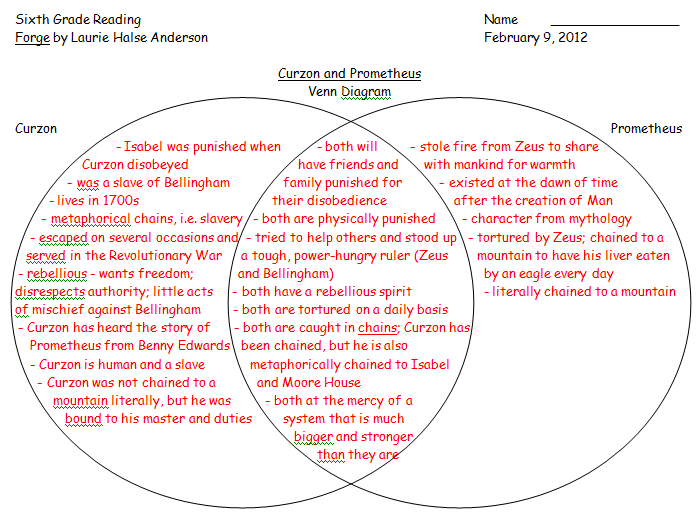
After discussing the famous tale of Prometheus, we discussed the ways in which Curzon is similar.  We created a Venn diagram of their similarities and differences, and during our discussion, the students discussed how both Curzon and Prometheus had experienced both literal and metaphorical chains.  This led us directly into our next activity...


We created chains to show how both heroes had experienced literal and metaphorical chains in their pursuit of doing what they felt was right.  I handed out a worksheet that included four long rectangles for filling in the "chains" of both characters.  Once we had filled in the different types of "chains," we cut out the strips and taped them into links of a chain. 


Throughout our reading of Forge, we have completed several reflective creative writing activities, including letters to and from characters, as well as "thought bubble" posters.  The bulletin board outside of our classroom displays these projects and activities, including the chains, and has actually drawn a lot of interest in the book.  Several students from other grades have asked about the book and we may even be adding the whole series, including the prequel, Chains, and the upcoming sequel, Ashes.  

Friday, January 20, 2012

Forge Food

In Laurie Halse Anderson's Revolutionary War novel Forge, there are vivid descriptions of the food, clothing and basic conditions that the soldiers endured during the winter encampment at Valley Forge.  We are very fortunate to go to school about one mile away from the historical site, so we decided to experience the book as fully as possible. 

Lately, the students have expressed a lot of curiosity about the firecake, porridge and vinegar sticky rice described in the book.  Today in class, we made these foods (to the best of our ability in a classroom) and the students enjoyed the experience, but it also made it very real what rations were like at the time.

During the war, often rations for an entire regiment included only a small cloth bag of flour.  During these times, soldiers would make "firecake."  Each soldier combined their ration of flour into a large pot and mixed it with creek water.  The pasty mixture would then be spread over heated flat rocks where it would bubble and sputter into a hard unleavened bread.  The taste was revolting and the texture was even worse by most accounts. 
Our firecake was prepared on heated stoneware in the classroom.  The hardened cakes were difficult to remove from the stone and tasted pretty terrible.  We tried to imagine, however, that the taste would have been worse had they been prepared with dirty creek water and on a real stone. 

Several students were also unfamiliar with porridge, so we made a modern version of this dish, as well.  Surprisingly, our students had never tasted plain oatmeal, so we prepared an oat porridge of fine-ground oats, water and salt. 

Finally, the book describes one instance when the rations included only rice.  The soldiers made a pot of sticky rice, again with heavily peppered creek water, then coated it in vinegar to ward off scurvy.  We made some simple brown rice in peppered water, then served it with a dash of white vinegar. 

Obviously, the students didn't care much for the war-era foods that we created, but that wasn't really the point.  Students were better able to imagine what life would have been like during the winter encampment that took place right here in our area over 200 years ago.  To wrap up the assignment, we wrote journal entries about the experiences of the soldiers. 

Tuesday, December 6, 2011

So you think you can classify?

One of my favorite ways to teach is through error and frustration.  Maybe that sounds mean, but one of the most "a-ha" activities that we do every year results in just that - mistakes, failure and frustration.

Before teaching our unit on Classification of Living Things, I decided a few years ago not to tell the kids what we would be learning next, but to just give an activity with easy-to-follow directions, but no guidance about why we were doing it.

I created a few identical decks of cards with pictures of forty-some animals on them.  Each group gets a deck of cards and is given the task to dividing the animals into two groups based on their characteristics.  Then, each of the two groups must be divided again into two groups.  They record their results on a sheet like this:


What the students do not realize, however, is that the groupings they create and the records that they keep are not really the goal of the assignment - it's the discussions that arise during the activity.  Inevitably, every system that the students devise during this process becomes a horrible failure.  Some students opt for the first two categories to be land and sea, but cannot decide about the frogs.  Some opt for big and small, but then struggle with the medium sized animals.  Some opt for furry and not furry, but struggle with classifying the birds and whales.

In the end, we have a whole-class discussion about some of the problems involved in their classification schemes.  Every year that we have done this activity, the students have drawn the same conclusions about the difficulty of classifying organisms - which characteristics are important and really show evolutionary relationships, and which ones are not.

Even though our textbook surprisingly does not describe the relationship between evolutionary relationships and common ancestors to classification, the students begin to make these connections during our conversation.  We just finished learning about evolution, natural selection and common ancestors, so the tie-in fits perfectly.

Naomi's Book of Lists

As anyone who has read our beloved sixth grade novel Becoming Naomi Leon by Pam Munoz Ryan knows, Naomi is good at three things: "1.) soap carving, 2.) worrying, and 3.) making lists."  As an activity for the length of the novel, we created our own "Books of Lists." 

Each student was provided with a notebook to create lists about the book, both from Naomi's perspective and their own.  Some lists were inspired by lists from the book, while other lists were created for students to reflect on the book. 

Because their homework and journaling assignments are so writing intensive and because writing is so effortful for many of our students, many found it refreshing to be able to write lists in phrase form, or simply jot down words.  They liked having at least one outlet for writing that wasn't checked for mechanics or written in complete sentences; one to simply reflect without the burden of the writing process. 

Below are some images of our books: