If you follow this blog at all, you know that much of my inspiration often comes from stories heard on NPR. This post is no exception. Recently, while running errands in the afternoon, I heard a story on All Things Considered about "teachers as performers" and the disparity between this reality and the extent to which we prepare teachers for this role in college and other degree programs.
In the story, teacher Amanda Siepiola describes channeling Bruce Springsteen and his seemingly effortless way of capturing a crowd of thousands. The story goes on to discuss the extent to which good teachers are not only fluent in curriculum, pedagogy, and content material, but also in performing.
This story struck me for three primary reasons. Firstly, I come from a family with more than a few devoted Bruce Springsteen fans. I have also felt many times that there was an element of performance and 'art' to the way that I teach, so the message of this story struck a chord. Finally, I felt a little more connected to this article since Bruce Lenthall, the executive director of the Center for Teaching and Learning at the University of Pennsylvania, was a professor of mine back when he was a visiting history lecturer at Bryn Mawr College.
Particularly in the comments section of the webpage for the story, many seem to have too literal an understanding of what exactly it is like and feels like to be both the "performer" and the student in the performance. Firstly, there is an implication in both the story and the comments that performances are one-way directional experiences and that, as a result, in order to consider a teacher a performer, we must be referring to a lecture-based, teacher-centered classroom. I don't believe that this really needs to be the case.
Speaking to this point, the example of Springsteen is particularly apt. When you see Springsteen, you don't watch him in wonder. He does more than just entertain you; you are part of the show. Otherwise reserved people can be seen dancing in the aisles. Fans bring posters with hundreds of non-Springsteen song titles, essentially challenging him and the E-Street Band to an impromtu jam session of Jackie Wilson's "Higher and Higher" or even "Santa Claus is Coming to Town." The audience watches Bruce and he plans the basic trajectory of the show, but the show changes based on the crowd and the location and the guidance of the audience.
Above is a photo, albeit a crummy cell phone picture, of a Springsteen show that I attended in 2012. It was his last ever show at Philadelphia's Spectrum before it was demolished, a fact that only added to the personal nature of the show. Bruce has banners emblazoned with his record-breaking number of sell-outs at the venue right along side retired player numbers. During each show, the house lights are turned on and the crowd is reminded that they are surrounded by "a few thousand of their closest friends." Minutes after this picture was taken, Bruce was running through the crowd, bringing fans on stage, and playing requests right from the crowd.
Perhaps this is a better description of the performance aspect of teaching. Outside the small minority of purely student-driven, inquiry-based classrooms (which also have their limitations as discussed here), the teacher brings a particular set of skills, experiences, and/or knowledge and guides the trajectory of the course based on specific curriculum and standards. The teacher's role is also not just to keep the kids "entertained," but also to engage and inspire.
Indeed even if a teacher does decide to embrace a methodology that shies away from lecture- or teacher-based instruction, it is clear that his or her enthusiasm will add interest and authenticity to the lesson, and perhaps this is just as much the so-called performance of teaching. Maybe the better question is, what does teaching look like without some aspect of performance? Regardless of the well-planned nature of the lesson or the background knowledge of the teacher, are these the lessons students view as 'boring?'
One thing is for sure -- teaching for me sure feels like a performance. I have spent time with my fair share of musicians given that my husband plays in a local metal band. These musicians often describe a unique feeling of performing that provides a heady feeling of accomplishment, but after the rush of wrapping up the show, they're wiped. This is in essence the late-night version of my teaching life.
When I do what I do, I feel absolutely in my element, like words and ideas are just flowing from me and I feel energized. As soon as the day is over, however, and I decompress and check emails, I am exhausted. And I don't think I am alone in this feeling. Being on is tiring and sharing your energy and creativity really takes it out of you.
For what it's worth, give yourself some credit! Here's to your inner-rockstar!
Friday, January 9, 2015
Tuesday, January 6, 2015
Have you checked out Understood?
Understood is really intended as a resource for parents of students with learning differences, but it can be tremendously helpful for teachers, as well.
The site has information about learning disabilities, simulations to "see the world through your child's eyes," and tools and forums for parents. They offer an email newsletter that provides frequent updates about new material.
To illustrate how this can be useful for teachers, today's email update featured reviews of apps that are useful for students with various learning problems and attention issues. The slideshow is featured here.
Reaching students with learning and attention issues can be challenging, especially for the many teachers who are so-called neurotypical and have never experienced these problems. Understood is a great resource for understanding the way children learn and reaching out to others in the community for support and strategies.
Tuesday, December 2, 2014
It's Club Season!
Now that the winter session is upon us, it is time for the winter club season here at our school! Over the next few weeks, I will be posting about some activities from my two clubs, the Middle School Art Club and the Middle and Upper School Comics and Gaming Club.
These projects can be easily adapted for students in regular art classes, as well as for teachers using comics and graphic novels in literature and content area courses. This is my first time running these particular clubs so I am excited to get started!
Keep on the lookout for the following upcoming activities:
Rope Bowls
Silhouette Paintings with Masking Technique
Stamped Clay Plates
Basic Jewelry Making
Creating Comics with Pixton Software
Making Superheroes with Marvel Site
Fantasy Board and Card Gaming
Monday, December 1, 2014
Washington Crosses the Delaware
Throughout my course, I find that I always want to teach a common tension throughout the entire field of historical scholarship -- understanding and familiarity with the accepted iconography and narrative, while also teaching an undertone of critical questioning into that narrative. I have found one example of that tension to be in Emanuel Leutze's iconic painting, Washington Crosses the Delaware. (Henry Wadsworth Longfellow's Paul Revere's Ride is another great example.)
For this lesson, I wanted to teach the event and familiarize students with the famous image of a stoic Washington braving the ice and snow in a surprise attack on Trenton while also discussing some of the context of the painting itself. For the first objective, we would reenact the painting. We spent some time creating some simple props for the scene, such as oars made from dollar store brooms, a boat made of posterboard propped up by crates, and assembling some costumes with everything from three-cornered hats to scarves and bedsheets.
The goal of this re-enactment was two-fold. Firstly, I wanted students to be familiar with the iconic image of Washington Crossing the Delaware. After completing this re-enactment, students found several examples of parodies and other images that used the recognizable icon including everything from the video game Assassin's Creed to My Little Pony.
Secondly, I wanted students to analyze how these images become part of the American memory and how they reflect popular themes in American memory and mythos. In a wrap-up written assignment after the simulation, we read into further detail about some inaccuracies in the painting and to what extent these were the artist's intentional creative license.
Finally, each student got a color printout of the picture from their class as a keepsake -- and they really loved this part! I have included one of the photos below with the students' faces blurred. Try this one out! It's a great one and makes for fantastic yearbook pictures!
Sunday, November 16, 2014
Scootin' for Newton
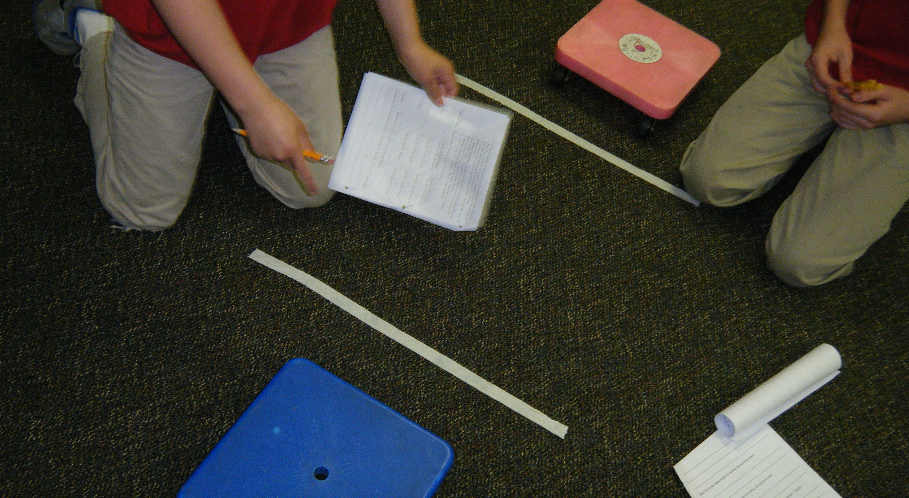
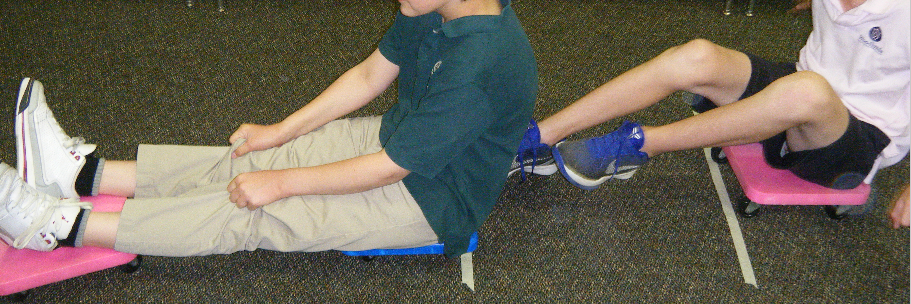
This week, I made my annual visit deep into the back of the P.E. closet to pull out the old scooters. It's Newton time again. While covering Newton's three laws of motion, we try to demonstrate each of the laws in class, and this demo works really well for Newton's third law.
It was really refreshing to revisit this demonstration since making the swap to 7th and 8th grade social studies two years ago. For the past year, I have been working on a special education certification and a second Master's degree in the field. My recent course had me revisiting math and science instruction, so I took a little break from my usual history-based routine to teach this lesson. I am editing this post to include some pictures from that demonstration.
For further information about how to conduct this lab, as well as some images of our lab sheets, check out my post from May 2011.
Here are some fun pictures from today:
Friday, March 21, 2014
Keep or Toss?
What can reality shows on television and the "real food" movement teach us about the future of education? It may seem like a stretch, but in reading some of the most recent writing out there about radical new teaching techniques, there may be some parallels worth considering.
You've probably seen those reality shows on TV in which a team of energetic people, usually in matching shirts, sweep into someone's house and clean it out. They sort through all of the clutter and then introduce a system of plastic bins and printed labels to reorganize a person's life. In at least a few iterations of these shows, there is always a series of tarps out on the front lawn for sorting objects labeled "keep" and "toss."
It seems to me that the world is immersed in a massive paradigm shift into a data- and computer-driven age and we are constantly re-evaluating how we interact with each other. Similarly, education, parenting and child development seems to be going through a similar shift -- a metaphorical "keep or toss" of traditional techniques. While it is impossible to ignore the differences in the way that today's young people interact with their world and each other, I sometimes wonder if too much of what we know as "good teaching" is going into the "toss" pile in favor of more free-form, inquiry-driven and high-tech practices.
The rapid pace of change in today's youth is particularly evident to me as a relatively young teacher. Sure, it has been commonplace for decades for adults to see huge differences in the way that young people use technology and behave socially, but to see such a dramatic change in less than one generation is a new phenomenon. It seems like the changes between generations are increasing at an exponential pace.
To acknowledge that this is happening is one thing, but should we fully embrace the way that young people are evolving as 100% inevitable and valuable? What is the perfect balance of what to "keep" and what to "toss?" What happens when too much is "tossed?"
There is no question that students are more successful and more likely to understand and retain information that is presented in a connected and creative way and that is relevant and based in student inquiry. This has been the primary push in educational research and teacher instruction for decades. In just my own career, however, of studying and practicing the art of teaching, this concept has broadened to the extent that much of education writing suggests throwing the entire school paradigm out the window in favor of technology-based student-guided projects and research into topics of exclusively their own choosing. An exemplary article describing this type of movement is this one from Wired.
So this leads me back to the keep piles and toss piles. When our culture largely moved past lecture-based teaching with massive class sizes, I was on board. When we tossed out student shaming as a means of discipline, it was for the better. Several aspects of traditional teaching have been put in the "toss" pile over the years and this was a necessary shift, if a slow one at times.
Even in my relatively young perspective, we seem to be standing at the precipice of putting an awful lot of stuff into the "toss" pile. I am worried that we may not value enough the parts of today's teaching that maybe should remain in the "keep."
The adults in my life have exposed me to subjects and ideas that I may never have discovered without them. They have provided insight into life experiences. They have shared their histories with me. I have also learned arts and skills that may be obsolete, but incredibly enjoyable. As I tell my students all the time, even if a skill or a tidbit of knowledge doesn't affect their lives directly, it puts a little wrinkle into their grey matter and makes them a more well-rounded person and a better thinker.
That said, I don't know if I am ready to give all of this adult input up to embrace a completely student-driven paradigm. And there are plenty of educational think tanks and writers out there would have me feel pretty guilty and entitled about making that statement. I may sound like I am overstating the recent push toward student inquiry, but
Lately, I have been reading through Michael Pollan's body of work about food. I have read Cooked and The Omnivore's Dilemma, but his book that really struck a chord with me recently was In Defense of Food: An Eater's Manifesto. The primary thread of the argument is that we as a society need to return to the "real food" of our grandparents' generation. Most of society embraced an industrial food model as the way of the future, as modern and empowering. Women were no longer required to spend countless hours in the home preparing foods by traditional means and other technologies, most notably television, became part of meal time experience.
Initially, this was perceived as the wave of the future, the inevitable march toward progress. Now, however, many deeply regret this transition. The American population is heavier than ever and while our expected lifespan is longer, we are suffering and dying from diet-related health conditions more than ever. Pollan quite convincingly argues that the processed versions of food are never as nutritious as the "real food," and we are paying the price in our mental and physical health. In addition, research has shown that the simple act of eating meals together makes for happier families, healthier diets and even lower rates of drug use and suicide in young people. In this case, the tech-driven wave of the future seems to have provided some progress -- like movement toward gender equality and wider food options -- but also has led us astray.
Why bring up this example of food? Today, the biggest movement in the world of culinaria is one that looks backward to an earlier time instead of toward the future. Locally-sourced and seasonal foods, organic agriculture, and "slow food" are the buzzwords of a culture that has found something wrong and downright dangerous in the quick and unquestioning embrace of how new technology changes ancient and essential human activities. As it turns out, cooking food and sharing it with our families at meal time was pretty darn important. Further, the legacy of our prior generations had something to teach us and it turned out to be really valuable.
I am worried that too quick of a jump into the "future of teaching" and fully embracing technology and the "connectedness" of today's socially-networked society might just be a repeat of the TV dinners and fast food of the last generation. Simply put, the needs and operations of the human mind may not evolve as quickly as our technologies do.
In no way am I arguing that technology should not be part of classroom instruction. As a matter of fact, ours is a very high-tech school and we are finding that assistive technologies like text-to-speech software, teacher websites and visual graphic generators are an important part of our instruction and I have blogged about several of them here, here, here and here, among many other posts. Instead, I hope to merely raise the question of how much is too much to "toss."
Students are exposed to new skills, topics and ideas through the expertise and experiences of the adults in their lives. Learning from adults in order to grow into adults is the quintessential part of youth and adolescence throughout all of human history. While it has been valuable to consider student inquiry, embrace young ingenuity and nourish the experience of childhood, it may be taking it too far when we flip the system on its head and only value the insight and motivation of young people. You can call it self-preservation or an inflated sense of purpose, but I do believe that I have something valuable to offer my students in my life of knowledge and experience, and I think most of them would be inclined to agree.
Artifacts from the Lewis and Clark Expedition
Once again, our textbook zips through another historical event that I felt deserved more attention, so we supplemented the text with a film and a project. I wanted my students to understand just how unknown and expansive the western frontier was during the earliest years of the United States. To say that the country was growing at an unparalleled rate is an understatement. During the Jefferson Administration, the country doubled in size with the Louisiana Purchase and the population nearly tripled. In order to explore and document this new territory, Jefferson appointed Meriwether Lewis and William Clark to traverse the terrain.
The fact that Jefferson still sought to find a Northwest Passage shows how little was known of the new territory. To explore the journey further, we watched National Geographic's production of Lewis & Clark: Great Journey West in class. In the film, we know that there were several goals of the expedition, but among them were to build friendly relations with Native Americans while also formally annexing their lands, but also documenting and mapping what they see and collecting artifacts of the people, animals and natural environment. According to this historical blog, many of these artifacts were dispersed and lost over time.
For our project, students used information from the text, the video and their own research to create their own "artifacts" that may have been lost. For example, it is known that Lewis and Clark spent a significant amount of time with the Mandan people of the Plains and brought back a buffalo hide depicting a battle scene. Several groups created buffalo hides depicting other scenes from the expedition using paper grocery bags. Others created journals with tales from the expedition and included leaves and bone fragments of species previously unknown.
I like this project for a few reasons:
- The students really enjoy any opportunity to use art and creativity. There are countless benefits to using technology in the classroom, but they really appreciate times when we power down the laptops and create something with just our hands and some art supplies.
- Creating these artifacts made students step back and think about how historical narratives like the textbook are created based on artifacts and other primary sources.
- Looking at the artifacts also forced students to reflect on the ways that our knowledge of our world was built. Only recently have we been able to map and observe our world with satellites, sonar and similar technologies. For most of human history, our collective knowledge of the world came from on-the-ground human exploration and experience.
For the project, students were allowed to create journals, samples, maps and other types of artifact evidence from the trip. They looked at online catalogs of real artifacts and watched a film that reenacted the journey to collect information, then began creating.
They made Mandan buffalo hides depicting famous battles and encounters, journals with leaf samples of real species from the west, as well as recreations of antique maps that showed the journey.
I found this project to be relatively flexible as far as timing and ability levels. Some students got really creative and researched more information about what Lewis and Clark actually collected. Others stayed very concrete and created maps or wrote journal entries. It was also fairly simple to adapt the requirements in order to accommodate shorter time periods as needed.
Subscribe to:
Posts (Atom)