I have written about edX courses before, but now I have a renewed appreciation for the massive open online course (MOOC) movement now that I am fully immersed in a new course. For the past few weeks, I have been following (and loving) renowned historian Eric Foner's second module of the three-part series of courses on the Civil War and Reconstruction.
You can imagine my delight when just a few days ago, Eric Foner was a guest on NPR's Fresh Air and that he was discussing a topic somewhat outside the scope of the course, the Underground Railroad. His new book, Gateway to Freedom: The Hidden History of the Underground Railroad mostly revolves around a few newly discovered sources from abolitionist and railroad operative Sydney Howard Gay.
His comments on the Underground Railroad were not only interesting, but they speak to the very tenets of "doing history" that historians relish, but few people truly understand. Many view the work of historians as either a stodgy pursuit of acquiring knowledge from dusty books, or, as a reflection of our digital- and science-driven times, as a pursuit of truth in a sea of misinformation. It certainly can be these things, but it is also a larger discourse of how history is shaped and narratives created and how the predominate narrative of an era defines the era itself.
In discussing the Underground Railroad we learn that the shifting understanding of what it was and its size and scope is similarly reflective of the times and scholars who study and create these narratives. How this story is told can be hugely symbolic of modern views on race politics and empowerment. The fact that so many narratives of the Railroad come from post-war memoirs and oral accounts is also telling about the nature of the story that persists.
While I certainly would like to report the most current research and discourse to my students when we cover topics such as this, I also hope to use overarching concepts like this to tackle more critical questions with my students. I want them to understand that history is not a set of definitive events, but instead a living creation that evolves along with the culture that consumes that history. Foner's new account of the Underground Railroad is just one piece of this conversation, and a good one at that.
Thursday, January 22, 2015

Friday, January 16, 2015
Imagining Life in the Mills
Because of the great success of our Roanoke Island mystery assignment, I wanted to give the students another authentic experience of sifting through documents and really "doing history." In our study of the early Industrial Revolution, I wanted to focus on the "mill girls" of Lowell, Massachusetts and their experiences in the factory textile mills.
To begin the assignment, I found some examples of modern child labor laws and had students write a journal entry about why they believe these laws exist and whether or not they agreed with them. Given that many of our students are nearing the age of legal employment with work permits in Pennsylvania, many of them came with background knowledge about what was required to enter the workforce.


To begin the assignment, I found some examples of modern child labor laws and had students write a journal entry about why they believe these laws exist and whether or not they agreed with them. Given that many of our students are nearing the age of legal employment with work permits in Pennsylvania, many of them came with background knowledge about what was required to enter the workforce.
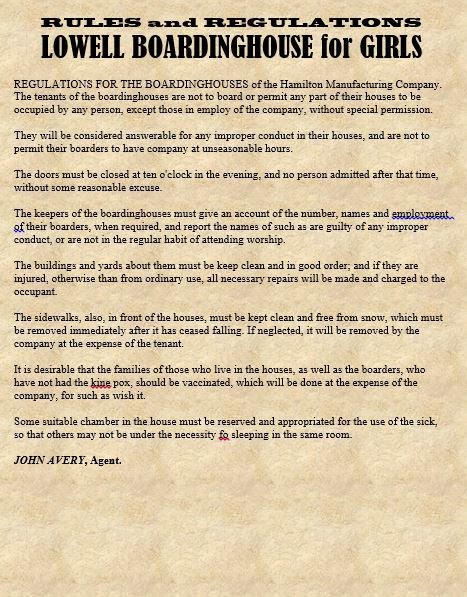
Like in the Roanoke assignment, I compiled a dossier of documents from the time period including rule sheets for the employees of the mills and the boardinghouses where the girls lived. Students read a government report into health concerns of mill employees, as well as a letter based on the description of the mills in the historical fiction novel for young adults, Lyddie by Katherine Paterson. I was also able to find an authentic rule sheet for both the factory and the boardinghouse that would have been distributed to workers. I retyped it and laminated it for the students to peruse.
After reading through the dossier, the students compiled a three-column chart of notes. Once they have the initial information, the teacher can really guide this lesson into any assignment or skill-building exercise that the curriculum requires. Because there is so much flexibility in how these documents can be used and indeed I have used them differently throughout the years, I have posted images of my typed versions of the documents for classroom use. For copyright reasons, I will allow teachers to choose their own excerpts from Lyddie.
A complete transcript of this report can also be found on the University of Massachusetts, Lowell's library site here.
More primary source text from the Lowell mills can also be found here.
Friday, January 9, 2015
Classroom Performers
If you follow this blog at all, you know that much of my inspiration often comes from stories heard on NPR. This post is no exception. Recently, while running errands in the afternoon, I heard a story on All Things Considered about "teachers as performers" and the disparity between this reality and the extent to which we prepare teachers for this role in college and other degree programs.
In the story, teacher Amanda Siepiola describes channeling Bruce Springsteen and his seemingly effortless way of capturing a crowd of thousands. The story goes on to discuss the extent to which good teachers are not only fluent in curriculum, pedagogy, and content material, but also in performing.
This story struck me for three primary reasons. Firstly, I come from a family with more than a few devoted Bruce Springsteen fans. I have also felt many times that there was an element of performance and 'art' to the way that I teach, so the message of this story struck a chord. Finally, I felt a little more connected to this article since Bruce Lenthall, the executive director of the Center for Teaching and Learning at the University of Pennsylvania, was a professor of mine back when he was a visiting history lecturer at Bryn Mawr College.
Particularly in the comments section of the webpage for the story, many seem to have too literal an understanding of what exactly it is like and feels like to be both the "performer" and the student in the performance. Firstly, there is an implication in both the story and the comments that performances are one-way directional experiences and that, as a result, in order to consider a teacher a performer, we must be referring to a lecture-based, teacher-centered classroom. I don't believe that this really needs to be the case.
Speaking to this point, the example of Springsteen is particularly apt. When you see Springsteen, you don't watch him in wonder. He does more than just entertain you; you are part of the show. Otherwise reserved people can be seen dancing in the aisles. Fans bring posters with hundreds of non-Springsteen song titles, essentially challenging him and the E-Street Band to an impromtu jam session of Jackie Wilson's "Higher and Higher" or even "Santa Claus is Coming to Town." The audience watches Bruce and he plans the basic trajectory of the show, but the show changes based on the crowd and the location and the guidance of the audience.

Above is a photo, albeit a crummy cell phone picture, of a Springsteen show that I attended in 2012. It was his last ever show at Philadelphia's Spectrum before it was demolished, a fact that only added to the personal nature of the show. Bruce has banners emblazoned with his record-breaking number of sell-outs at the venue right along side retired player numbers. During each show, the house lights are turned on and the crowd is reminded that they are surrounded by "a few thousand of their closest friends." Minutes after this picture was taken, Bruce was running through the crowd, bringing fans on stage, and playing requests right from the crowd.
Perhaps this is a better description of the performance aspect of teaching. Outside the small minority of purely student-driven, inquiry-based classrooms (which also have their limitations as discussed here), the teacher brings a particular set of skills, experiences, and/or knowledge and guides the trajectory of the course based on specific curriculum and standards. The teacher's role is also not just to keep the kids "entertained," but also to engage and inspire.
Indeed even if a teacher does decide to embrace a methodology that shies away from lecture- or teacher-based instruction, it is clear that his or her enthusiasm will add interest and authenticity to the lesson, and perhaps this is just as much the so-called performance of teaching. Maybe the better question is, what does teaching look like without some aspect of performance? Regardless of the well-planned nature of the lesson or the background knowledge of the teacher, are these the lessons students view as 'boring?'
One thing is for sure -- teaching for me sure feels like a performance. I have spent time with my fair share of musicians given that my husband plays in a local metal band. These musicians often describe a unique feeling of performing that provides a heady feeling of accomplishment, but after the rush of wrapping up the show, they're wiped. This is in essence the late-night version of my teaching life.
When I do what I do, I feel absolutely in my element, like words and ideas are just flowing from me and I feel energized. As soon as the day is over, however, and I decompress and check emails, I am exhausted. And I don't think I am alone in this feeling. Being on is tiring and sharing your energy and creativity really takes it out of you.
For what it's worth, give yourself some credit! Here's to your inner-rockstar!
In the story, teacher Amanda Siepiola describes channeling Bruce Springsteen and his seemingly effortless way of capturing a crowd of thousands. The story goes on to discuss the extent to which good teachers are not only fluent in curriculum, pedagogy, and content material, but also in performing.
This story struck me for three primary reasons. Firstly, I come from a family with more than a few devoted Bruce Springsteen fans. I have also felt many times that there was an element of performance and 'art' to the way that I teach, so the message of this story struck a chord. Finally, I felt a little more connected to this article since Bruce Lenthall, the executive director of the Center for Teaching and Learning at the University of Pennsylvania, was a professor of mine back when he was a visiting history lecturer at Bryn Mawr College.
Particularly in the comments section of the webpage for the story, many seem to have too literal an understanding of what exactly it is like and feels like to be both the "performer" and the student in the performance. Firstly, there is an implication in both the story and the comments that performances are one-way directional experiences and that, as a result, in order to consider a teacher a performer, we must be referring to a lecture-based, teacher-centered classroom. I don't believe that this really needs to be the case.
Speaking to this point, the example of Springsteen is particularly apt. When you see Springsteen, you don't watch him in wonder. He does more than just entertain you; you are part of the show. Otherwise reserved people can be seen dancing in the aisles. Fans bring posters with hundreds of non-Springsteen song titles, essentially challenging him and the E-Street Band to an impromtu jam session of Jackie Wilson's "Higher and Higher" or even "Santa Claus is Coming to Town." The audience watches Bruce and he plans the basic trajectory of the show, but the show changes based on the crowd and the location and the guidance of the audience.
Above is a photo, albeit a crummy cell phone picture, of a Springsteen show that I attended in 2012. It was his last ever show at Philadelphia's Spectrum before it was demolished, a fact that only added to the personal nature of the show. Bruce has banners emblazoned with his record-breaking number of sell-outs at the venue right along side retired player numbers. During each show, the house lights are turned on and the crowd is reminded that they are surrounded by "a few thousand of their closest friends." Minutes after this picture was taken, Bruce was running through the crowd, bringing fans on stage, and playing requests right from the crowd.
Perhaps this is a better description of the performance aspect of teaching. Outside the small minority of purely student-driven, inquiry-based classrooms (which also have their limitations as discussed here), the teacher brings a particular set of skills, experiences, and/or knowledge and guides the trajectory of the course based on specific curriculum and standards. The teacher's role is also not just to keep the kids "entertained," but also to engage and inspire.
Indeed even if a teacher does decide to embrace a methodology that shies away from lecture- or teacher-based instruction, it is clear that his or her enthusiasm will add interest and authenticity to the lesson, and perhaps this is just as much the so-called performance of teaching. Maybe the better question is, what does teaching look like without some aspect of performance? Regardless of the well-planned nature of the lesson or the background knowledge of the teacher, are these the lessons students view as 'boring?'
One thing is for sure -- teaching for me sure feels like a performance. I have spent time with my fair share of musicians given that my husband plays in a local metal band. These musicians often describe a unique feeling of performing that provides a heady feeling of accomplishment, but after the rush of wrapping up the show, they're wiped. This is in essence the late-night version of my teaching life.
When I do what I do, I feel absolutely in my element, like words and ideas are just flowing from me and I feel energized. As soon as the day is over, however, and I decompress and check emails, I am exhausted. And I don't think I am alone in this feeling. Being on is tiring and sharing your energy and creativity really takes it out of you.
For what it's worth, give yourself some credit! Here's to your inner-rockstar!
Tuesday, January 6, 2015
Have you checked out Understood?
Understood is really intended as a resource for parents of students with learning differences, but it can be tremendously helpful for teachers, as well.
The site has information about learning disabilities, simulations to "see the world through your child's eyes," and tools and forums for parents. They offer an email newsletter that provides frequent updates about new material.
To illustrate how this can be useful for teachers, today's email update featured reviews of apps that are useful for students with various learning problems and attention issues. The slideshow is featured here.
Reaching students with learning and attention issues can be challenging, especially for the many teachers who are so-called neurotypical and have never experienced these problems. Understood is a great resource for understanding the way children learn and reaching out to others in the community for support and strategies.
The site has information about learning disabilities, simulations to "see the world through your child's eyes," and tools and forums for parents. They offer an email newsletter that provides frequent updates about new material.
To illustrate how this can be useful for teachers, today's email update featured reviews of apps that are useful for students with various learning problems and attention issues. The slideshow is featured here.
Reaching students with learning and attention issues can be challenging, especially for the many teachers who are so-called neurotypical and have never experienced these problems. Understood is a great resource for understanding the way children learn and reaching out to others in the community for support and strategies.
Tuesday, December 2, 2014
It's Club Season!
Now that the winter session is upon us, it is time for the winter club season here at our school! Over the next few weeks, I will be posting about some activities from my two clubs, the Middle School Art Club and the Middle and Upper School Comics and Gaming Club.
These projects can be easily adapted for students in regular art classes, as well as for teachers using comics and graphic novels in literature and content area courses. This is my first time running these particular clubs so I am excited to get started!
Keep on the lookout for the following upcoming activities:
Rope Bowls
Silhouette Paintings with Masking Technique
Stamped Clay Plates
Basic Jewelry Making
Creating Comics with Pixton Software
Making Superheroes with Marvel Site
Fantasy Board and Card Gaming
These projects can be easily adapted for students in regular art classes, as well as for teachers using comics and graphic novels in literature and content area courses. This is my first time running these particular clubs so I am excited to get started!
Keep on the lookout for the following upcoming activities:
Rope Bowls
Silhouette Paintings with Masking Technique
Stamped Clay Plates
Basic Jewelry Making
Creating Comics with Pixton Software
Making Superheroes with Marvel Site
Fantasy Board and Card Gaming
Monday, December 1, 2014
Washington Crosses the Delaware
Throughout my course, I find that I always want to teach a common tension throughout the entire field of historical scholarship -- understanding and familiarity with the accepted iconography and narrative, while also teaching an undertone of critical questioning into that narrative. I have found one example of that tension to be in Emanuel Leutze's iconic painting, Washington Crosses the Delaware. (Henry Wadsworth Longfellow's Paul Revere's Ride is another great example.)
For this lesson, I wanted to teach the event and familiarize students with the famous image of a stoic Washington braving the ice and snow in a surprise attack on Trenton while also discussing some of the context of the painting itself. For the first objective, we would reenact the painting. We spent some time creating some simple props for the scene, such as oars made from dollar store brooms, a boat made of posterboard propped up by crates, and assembling some costumes with everything from three-cornered hats to scarves and bedsheets.
The goal of this re-enactment was two-fold. Firstly, I wanted students to be familiar with the iconic image of Washington Crossing the Delaware. After completing this re-enactment, students found several examples of parodies and other images that used the recognizable icon including everything from the video game Assassin's Creed to My Little Pony.

Secondly, I wanted students to analyze how these images become part of the American memory and how they reflect popular themes in American memory and mythos. In a wrap-up written assignment after the simulation, we read into further detail about some inaccuracies in the painting and to what extent these were the artist's intentional creative license.


For this lesson, I wanted to teach the event and familiarize students with the famous image of a stoic Washington braving the ice and snow in a surprise attack on Trenton while also discussing some of the context of the painting itself. For the first objective, we would reenact the painting. We spent some time creating some simple props for the scene, such as oars made from dollar store brooms, a boat made of posterboard propped up by crates, and assembling some costumes with everything from three-cornered hats to scarves and bedsheets.
The goal of this re-enactment was two-fold. Firstly, I wanted students to be familiar with the iconic image of Washington Crossing the Delaware. After completing this re-enactment, students found several examples of parodies and other images that used the recognizable icon including everything from the video game Assassin's Creed to My Little Pony.
Secondly, I wanted students to analyze how these images become part of the American memory and how they reflect popular themes in American memory and mythos. In a wrap-up written assignment after the simulation, we read into further detail about some inaccuracies in the painting and to what extent these were the artist's intentional creative license.
Finally, each student got a color printout of the picture from their class as a keepsake -- and they really loved this part! I have included one of the photos below with the students' faces blurred. Try this one out! It's a great one and makes for fantastic yearbook pictures!
Sunday, November 16, 2014
Scootin' for Newton
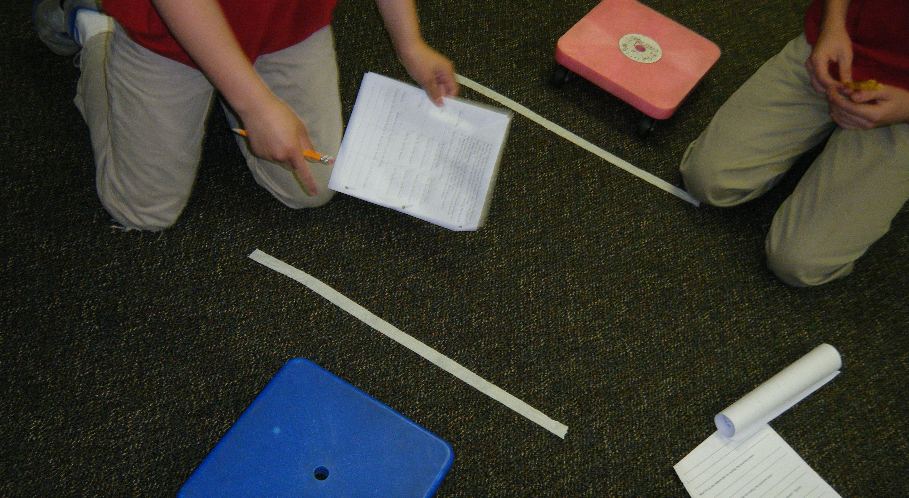
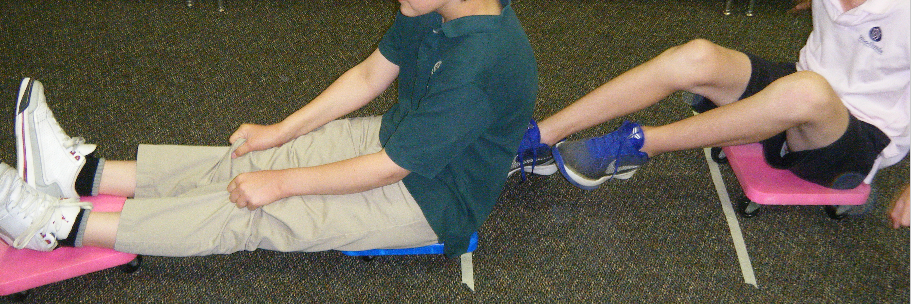
This week, I made my annual visit deep into the back of the P.E. closet to pull out the old scooters. It's Newton time again. While covering Newton's three laws of motion, we try to demonstrate each of the laws in class, and this demo works really well for Newton's third law.
It was really refreshing to revisit this demonstration since making the swap to 7th and 8th grade social studies two years ago. For the past year, I have been working on a special education certification and a second Master's degree in the field. My recent course had me revisiting math and science instruction, so I took a little break from my usual history-based routine to teach this lesson. I am editing this post to include some pictures from that demonstration.
For further information about how to conduct this lab, as well as some images of our lab sheets, check out my post from May 2011.
Here are some fun pictures from today:


It was really refreshing to revisit this demonstration since making the swap to 7th and 8th grade social studies two years ago. For the past year, I have been working on a special education certification and a second Master's degree in the field. My recent course had me revisiting math and science instruction, so I took a little break from my usual history-based routine to teach this lesson. I am editing this post to include some pictures from that demonstration.
For further information about how to conduct this lab, as well as some images of our lab sheets, check out my post from May 2011.
Here are some fun pictures from today:

Subscribe to:
Posts (Atom)