Thursday, May 24, 2012

Word Clouds

A few months ago, I posted about Wordle and some of its uses in education.  Within a few days of creating that post, I walked down the hallways of my own school and saw Wordle-like word clouds in the shapes of flowers, hearts, even the USA.  I had to find out how to do that myself.

There are several word cloud generators out there, but lately I have been experimenting with Tagxedo.  This generator allows you to make word clouds of websites, news stories, Twitter feeds and even web searches, then choose a shape for the cloud from tons of templates. 

For created shaped clouds and using web sources, Tagxedo is much better than Wordle.  If you intend to copy and paste text, however, Wordle is the better choice.  Tagxedo currently does not have a field for entering text. 


The United States Constitution

There are functions in Tagxedo for respinning, fonts, colors, shapes and even omitting words.  Play with all of the functions and see what awesome images you can create.  It's fun!

Electronic Binders

Just a few years ago, if you had peered into my closets, you would have seen stacks and stacks of binders.  Back then, the most logical way to organize and maintain my materials was to keep paper copies marked with notes and comments.  I always had electronic copies, as well, but the sequence of the papers worked for me and made sense.

About two years ago, I started saving things electronically in my files only.  It relieved some of the clutter and I even found ways to leave myself notes and tips on the documents themselves.  I have recently started using Dropbox, as well. 

Dropbox is awesome for pure storage.  It allows you to access documents from any internet connected computer, which is a huge plus.  Just like saving to the school's server, however, it is difficult to sort the items with any particular order or to mix file types.


It seems, however, that the only way a binder can truly be replaced is with a LiveBinder.  LiveBinders is a free service website that allows you to create electronic binders with any sequence.  Your binders can also include websites and other types of material that would be incompatible with traditional files. 

There are tons of resources out there like Dropbox and LiveBinder that allow you to store and access files electronically.  So, go ahead!  This summer, clean out those closets and get rid of all that clutter!  And next year, save a tree by saving your documents online instead of all that printing!

Fun with QR Codes

QR codes are everywhere and chances are, your students have the means and the know-how to use them.  As I said in my BYOT post, technology is here and you can either embrace it in the classroom, or expend a lot of energy swimming against the current!  QR codes are a great way to cut out the confusion of finding and managing materials while also using students tablets and mobile devices in a useful, meaningful way.

For those who are new to QR codes, it is a scannable image that contains alphanumeric information.  Your mobile phone or tablet device reads the information and understands it as either a web URL, calendar event, plain text, address or link to media, then takes you directly to that site.  For students, it's a great way to guide them to a website or document without copying lengthy addresses from another source.

For example, this is a QR code for this blog.  If you scan it with a mobile device, it will take you directly to this blog with no typing or copying required.


There are countless sites on the web that generate the codes for free.  Once you have the code, you can insert it into documents, posters, business cards and websites.  For our purposes, we created poetry Glogs featuring our favorite poems.  Because Glogs are best viewed online, we showcased them to the school community online.  Each student received a QR coded link to their Glog and we made flyers and cards to share with others.  This way, parents and other students can see the Glogs without actually walking past a bulletin board display.

If you have used QR codes in your classroom, or if you have ideas for other ways to use them, please leave a comment below!

Wednesday, May 23, 2012

Two roads diverged in a yellow wood...

After yesterday's analysis of Langston Hughes's Mother to Son and Edip Cansever's The Table, we read another all-time favorite and life metaphor - Robert Frost's The Road Not Taken.  The students immediately picked up on the metaphor for life's choices, so we began to reflect on the choices that others have made. 

Each student was given a diagram of two paths in the woods, then a prompt about a character from literature or history.  They described the two choices that this individual faced at some point, then analyzed the choice they ultimately made. 

For each character/figure, the students answered the following questions:

What were the two choices?  Choice #1?  Choice #2?

Which choice did they make?  (Draw an arrow on the path.)

Did he/she chose the "road less traveled?"

Would you make the same choice if you were in his/her position?


Later on, students drew a model of their lives as a path, featuring twists, turns, bumps and forks in the road.  I just love seeing them thinking about abstract concepts and metaphors!

You Just Got Pi'ed!

This activity is obviously related to circles, but it could also be a fun one for Pi Day celebrations.  It requires a little preparation, though. 

In the days leading up to the activity, ask students to bring in some kind of round treat, such as Oreos, doughnuts, bagel chips, cucumber slices, etc.  Make up a few plates of different-sized treats, then print out copies of the secret "pi'ed" poem, shown below.  


Throughout the day, students must stealthfully and anonymously place the treats into the classrooms of other teachers.  Depending on your school policies, you may want to preempt this with an email or a list of willing participants.  After each class finds the circumference of their treats, they are allowed to eat them as long as they promise to pay it forward! 


Textbooks of the Future

At our school, we are well on our way to making lessons and readings more tech savvy.  Each teacher maintains a website and all of our course documents are downloadable from these sites.  What remains, however, are the textbooks. 

We have some online subscriptions to some of our books, but the online versions are often just PDFs of the original text.  This helps with the problem of heavy backpacks, but does little to enhance the format of the text itself. 

More and more publication companies are embracing Kindles, Nooks and iPads as a means of reading their material.  Not only does this compile all of a student's texts onto one tiny reader/tablet, but it allows for functions that would be impossible for a paper textbook.  If you are not yet convinced, check out this demo of iBooks textbooks for iPad.

With these new formats, videos and demonstrations can be embedded into the text in place of still photos.  Many of the books also have applications for taking notes, making notecards and generating study quizzes. 


At the moment, we have a few iPads to share amongst the faculty and each student has a netbook.  We are not yet equipped for a full transition over to eTextbooks, but I am excited to see how this takes off in the future!

Tuesday, May 22, 2012

No Crystal Stair

The best part about teaching poetry to my sixth grade reading group is sharing my favorite poems with them.  Long ago when we initially planned this unit, we felt that it was important to begin sharing famous and more meaningful poems now that our students have moved on to middle school.  One of the poems we chose to feature was Langston Hughes's Mother to Son.

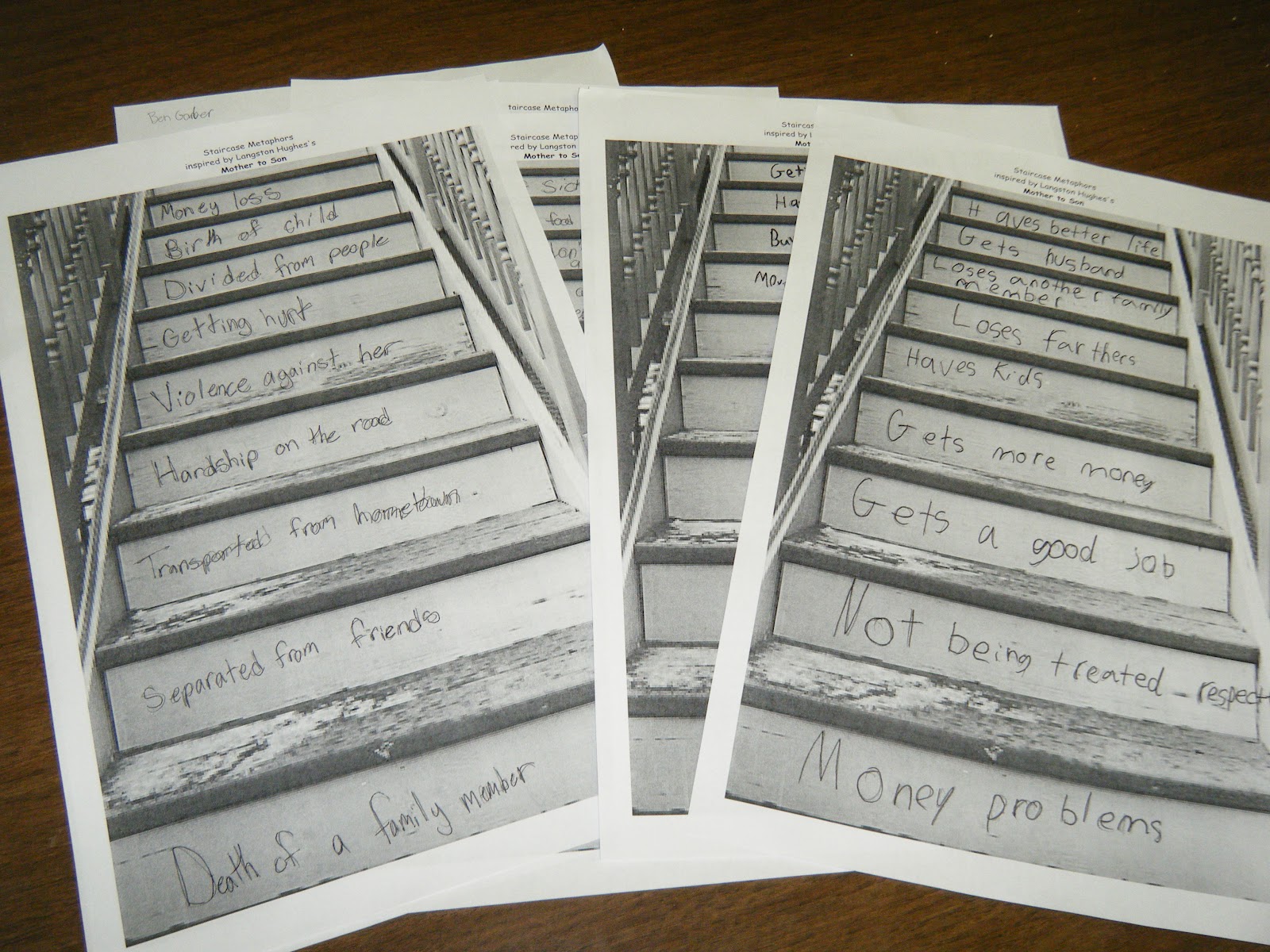
In the famous poem, the mother narrator describes her life as a metaphorical staircase.  She describes "tacks" and "splinters" along the way, but she continues "a-climbin' on."  Given the emphasis on figurative language in fifth and sixth grade curricula, we decided to really take this metaphor and run with it. 

First, we have students reflect on their background knowledge pre-Civil Rights Movement United States.  I asked them to brainstorm some ideas about what those tacks and splinters might have been in the mother's life, as well as the victories and "turned corners."  Once they have brainstormed, they organize their thoughts onto a poster of a staircase. 

Finally, students will write about their own "stair" as a homework assignment. 


Earlier this week, we read another poem featuring a life metaphor, Edip Cansever's The Table.  After reading both poems, we also created a Venn diagram comparing the metaphors for life in both poems - a table and a staircase.  More than anything, comparing these two poems and their tone really got the students to start thinking metaphorically and to think critically about the abstract meaning of poetry.