Monday, April 2, 2012

Growing Crystals

In our book, it describes two ways that crystals can form from solution - when water evaporates and leaves the mineral ions behind, or when the solution is so concentrated with dissolved ions that they form in the solution.  We decided to model these two phenomena in our classroom in the simplest way - by showing salt and sugar crystals.

Salt crystals are incredibly easy to show from solution and they look pretty striking when they are done.  For our demonstration, we mixed a solution of salt and warm water, then simply poured it into a shallow pan.  As the water evaporates away overnight, the slow process allows the salt ions time to re-connect into cubic crystals.

Depending on several variables in the solution, the crystals can be tiny cubic growths, or much larger.  Below are some images of both smaller and larger crystals.


Demonstrating crystals forming in solution is a little trickier.  We decided to make rock candy in the classroom.  In a pot or saucepan, mix two parts sugar to one part water and bring the solution to a boil.  This is the only way to ensure that the sugar is completely dissolved.  We used a simple lab burner to do so.  Once the solution has boiled, you can suspend either a string with a weight on the end or a popsicle stick into the solution.  We created a cross-shaped apparatus out of two popsicle sticks and a rubber band to make sure that the stick did not touch the bottom or get stuck to the sides. 

The salt crystals are typically ready overnight depending on the depth of the water.  I will usually move onward with whatever lesson is scheduled for that day, then allow the students a few minutes at the end of class to analyze their salt crystals and record some data into their lab packets.

The sugar crystals typically take 4-7 days, but some small crystals can be seen in those first few days.  Students will also do the regularly-scheduled lesson for that day, then record their observations on the last day of class.  Technically, these sugar crystals are edible after a quick rinse and a few minutes to dry.

Often, the sugar crystals can be a bit tricky and tend to form along the sides of the cup or beaker more so than along the stick or string.  Either way, crystals will form and they are typically large enough for the kids to pull them out and examine them.  Below is an image of sugar crystals that formed predominantly along the inside of the cup.

Monday, March 19, 2012

Wonders of Wordle

When I first heard about Wordle.net, I thought that it was a really cool concept, but I wasn't sure exactly how I would incorporate it into lessons.  Below I have described some of the lessons that I have designed using the website.

Wordle is a website that takes text from any source and converts it into a visual representation of the text.  It analyzes it and makes the size of the word as it appears in the "wordle" is proportional to the number of times it is used in the text.  You can either copy and paste text from another source, or you can list the URL of a website or blog and create a wordle of that text. 

First, Wordle will generate an image that features a randomly-selected combination of fonts and colors, but all of these things can be customized.  Wordle is also smart enough to restrict frequently used words like "and" or "the" and just use more meaningful words and names from the text.  Finally, once the wordle is generated, you can customize it and remove certain words. 

Below are some examples of how teachers all over the country have used Wordle.

This student copied and pasted the entire text of the United States Constitution to create this wordle.

This Wordle uses a research paper on the history of Japan as its source material.


Instead of copying and pasting, you can also list a URL and the site will pull all of the text from that site.  Just for fun, here is a wordle of my blog.


Back to business, we used wordles in our reading class this week and it was quite successful.  We are half-way into Cornelia Funke's The Thief Lord, and the plot is really beginning to thicken, so I thought it was time to reflect on what we had already read to revisit the build up of suspense.  Each student was assigned a chunk of pages from the past 25 chapters and reread it to refresh their memory. 

Once they had reread the passage, students wrote a two-paragraph summary of the events in that section.  We copied and pasted the text into Wordle and created images of the summaries.  We printed the summaries and each student wrote their name on the back of the wordle.

Each student received a slip of paper with the names of each other student in the class.  We silently passed the wordles around the room in a rotation and tried to pinpoint the exact moment in the story that the wordle described.  As they came up with their guesses, they recorded them on the slip next to each students' name. 

At the end of the activity, each student was invited to share their wordle with the class, then take their classmates' guesses about which scene they described.  The students' guesses were mostly accurate, but we found that this was significantly more challenging than the similar guessing game we played with text-rendered poems earlier in the year. 

All in all, it was a successful experience, and it also got the students used to the workings of Wordle.  We can use this website in the future as a writing aid, for finding over-used words, a summarizing tool, for finding main ideas, and as a fun way to visualize text from all subjects. 


I bet if I made a wordle of this post, the word "wordle" would be really big...

Wednesday, February 29, 2012

Inspired by Inspiration

Have you checked out the software Inspiration?  It's definitely worth a look.

We are fortunate enough to have this software preloaded on all student and teacher laptops, but many of the kids still do not know how to use it.  Inspiration is a software that allows you to type information into graphic organizers or webs.  There are several different options for these bubbles, as well, including shapes, images, colors and formatting. 

These webs allow students to visually organize information for practice when worksheets or more traditional study methods have become tedious or ineffective.  There are also tons of templates preloaded into the software for common topics in reading, math, science, social studies and music. 

Earlier this week, we tackled the topic of cells, tissues, organs and systems, and to me, this subject matter needs visual organization for it to make sense.  To display this idea, we created webs of six of the human systems (digestive, respiratory, circulatory, muscular, nervous, and skeletal) and mapped out their parts (organs) with images of the cells.  This way, students had an electronic document showing the diverse appearances of different human cells.


We have used these kinds of webs in reading and science with much success.  What is even more exciting, however, are the potentialities for writing.  As long as the web bubbles and links are formatted correctly, Inspiration can take the web and convert it into an outline.  This outline is printable and can also be copied into Microsoft Word for crafting essays and paragraphs.  Get inspired!

Friday, February 24, 2012

Mitosis Virtual Lab

We've already dragged out the microscopes a few times during this cell unit, but it would have been quite a feat to get them out again and find just the right sample with cells in the process of mitosis.  Instead, we conducted a virtual lab online to view actual cells in mitosis and identify the stages. 

As is the routine in all of our labs, students had to maintain a lab packet, follow the scientific method and answer reflective questions, but the inquiry itself was occurring virtually on screen.  Students were provided with a link to Rutgers University's online biology labs and completed Lab #2 on Cell Reproduction. 

During this lab, students viewed a sample of plant cells (onion root tip), as well as animal cells (whitefish blastulae) and identified the stages of mitosis.  They also had to reflect on the differences in the stages in each sample.  Also important, students always must make sketches of what they have seen in order to properly visualize the concept or task at hand, and also to look back to in their science journals for reference. 

Finally, after completing the steps of the virtual lab, they answered thoughtful and inferential questions in their packets designed for them to draw on their knowledge and reflect on what they have seen.  The packet that we used is shown below:


Yesterday was our first attempt at a true, independent virtual lab and it was very successful.  While I value the experience of preparing slides and looking through scopes at real samples, virtual labs are a great way to capture particular events or processes in a cell that might otherwise be missed in a classroom-prepared slide.  Virtual labs are also particularly important when supplies are limited so that students can still see and experience the concepts rather than just reading or hearing about them.  Particularly when we delve into the physical sciences, it can often be difficult to model certain natural phenomena in the classroom and I look forward to incorporating more virtual labs into the curriculum.  

Welcome to Cellville

Each winter, we study cells in sixth grade.  Aside from the obvious importance of the topic, we also get input from teachers in grades 7 and up about how much a good foundation in cell biology affects their successful understanding in future science courses.  Tackling so many new terms, however, and remembering their functions in the cell can be a real challenge for our students.

To improve understanding of cell organelles and their functions, one of our biggest science projects of the year, Cellville, creates a huge analogy between a cell and a city.  Each organelle is compared to a particular function in a city.  Students then create images that creatively combine the actual appearance of the organelle to the city institution to which it is being compared.  Each group must then create two paragraphs describing the organelle and its function, then explaining how it is like a post office, government, etc.


We grouped the students into pairs to complete this task.  Each partner had to contribute to both parts of the assignment.  When the pictures and paragraphs were complete, we arranged the organelles inside two giant cell models on the bulletin board in the hallway.  We created a plant cell and an animal cell to demonstrate the differences between both types of cells.


Teaching organelles and their functions is already a challenge given the complex vocabulary, but it is even more difficult because the students cannot actually see, therefore visualize, what is being described.  To make the organelles "life-size" and connect their functions to things that are already familiar has really made a difference in their understanding.  This project has been a success for the past three years, and each year I learn new strategies and methods to expand on this assignment and make it more effective.

Chains

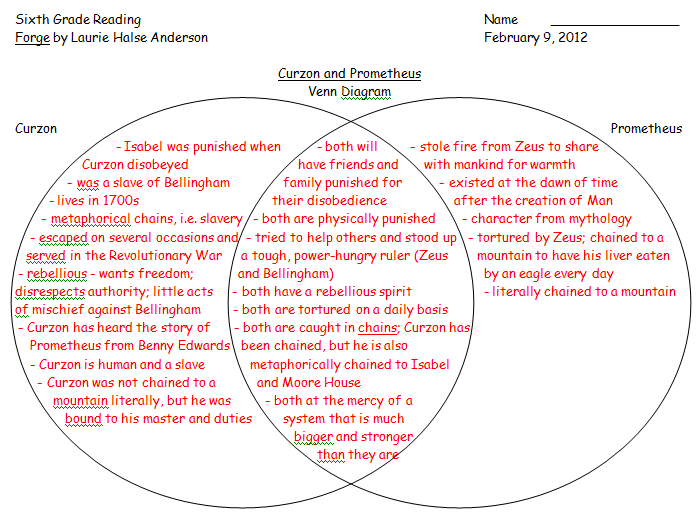
While reading Laurie Halse Anderson's Forge, the main character, Curzon, encounters hardship as both an enlisted soldier in the Valley Forge winter encampment and as a recaptured slave.  Though he is uneducated and unable to read or write, he recalls a story that he heard from another soldier about a man who defied the gods to do what was right and was punished brutally for it.  He compares his hardship to this story.

Given that we had already read some ancient Greek mythology earlier in the year, this piqued the students' interest.  The story to which Curzon is referring is the myth of Prometheus, the second-generation Titan and champion of mortal man.  Even though he was forbidden to do so by Zeus, Prometheus stole the power of fire and gave it to mortals.  As punishment, he was chained to the side of a mountain to have his liver eaten by eagles, only to regrow each night and start the torture anew the next day. 

After discussing the famous tale of Prometheus, we discussed the ways in which Curzon is similar.  We created a Venn diagram of their similarities and differences, and during our discussion, the students discussed how both Curzon and Prometheus had experienced both literal and metaphorical chains.  This led us directly into our next activity...


We created chains to show how both heroes had experienced literal and metaphorical chains in their pursuit of doing what they felt was right.  I handed out a worksheet that included four long rectangles for filling in the "chains" of both characters.  Once we had filled in the different types of "chains," we cut out the strips and taped them into links of a chain. 


Throughout our reading of Forge, we have completed several reflective creative writing activities, including letters to and from characters, as well as "thought bubble" posters.  The bulletin board outside of our classroom displays these projects and activities, including the chains, and has actually drawn a lot of interest in the book.  Several students from other grades have asked about the book and we may even be adding the whole series, including the prequel, Chains, and the upcoming sequel, Ashes.  

Friday, January 20, 2012

Forge Food

In Laurie Halse Anderson's Revolutionary War novel Forge, there are vivid descriptions of the food, clothing and basic conditions that the soldiers endured during the winter encampment at Valley Forge.  We are very fortunate to go to school about one mile away from the historical site, so we decided to experience the book as fully as possible. 

Lately, the students have expressed a lot of curiosity about the firecake, porridge and vinegar sticky rice described in the book.  Today in class, we made these foods (to the best of our ability in a classroom) and the students enjoyed the experience, but it also made it very real what rations were like at the time.

During the war, often rations for an entire regiment included only a small cloth bag of flour.  During these times, soldiers would make "firecake."  Each soldier combined their ration of flour into a large pot and mixed it with creek water.  The pasty mixture would then be spread over heated flat rocks where it would bubble and sputter into a hard unleavened bread.  The taste was revolting and the texture was even worse by most accounts. 
Our firecake was prepared on heated stoneware in the classroom.  The hardened cakes were difficult to remove from the stone and tasted pretty terrible.  We tried to imagine, however, that the taste would have been worse had they been prepared with dirty creek water and on a real stone. 

Several students were also unfamiliar with porridge, so we made a modern version of this dish, as well.  Surprisingly, our students had never tasted plain oatmeal, so we prepared an oat porridge of fine-ground oats, water and salt. 

Finally, the book describes one instance when the rations included only rice.  The soldiers made a pot of sticky rice, again with heavily peppered creek water, then coated it in vinegar to ward off scurvy.  We made some simple brown rice in peppered water, then served it with a dash of white vinegar. 

Obviously, the students didn't care much for the war-era foods that we created, but that wasn't really the point.  Students were better able to imagine what life would have been like during the winter encampment that took place right here in our area over 200 years ago.  To wrap up the assignment, we wrote journal entries about the experiences of the soldiers.